

↑ ECHOE II, pigments on marble, 24 x 11 x 9 cm, 2024
Igor Bleischwitz is a Berlin-based artist known for his multi-disciplinary approach, blending painting, ceramics, and textiles. His work often explores the tension between realism and abstraction, using a unique technique of layering and scraping paint to reveal hidden depths within his compositions. Inspired by historical and archeological references, Bleischwitz’s art delves into themes of memory, history, and the passage of time, encouraging viewers to uncover the narratives beneath the surface and contemplate the evolution of visual representation across different eras.
Igor Bleischwitz website and Instagram.

Your work often incorporates elements reminiscent of cave paintings, antique frescoes, and torn street posters. How do these historical and archeological influences shape the narratives and visual language in your art?
Cave paintings represent some of the earliest forms of human visual expression, with their depictions reduced to the essentials, which is precisely what gives them their powerful impact. In contrast, the frescoes from antiquity and the period shortly after are filled with realistic depictions, including accurate proportions and what we would now describe as 3D effects. Over time, these frescoes have often become incomplete, leaving only fragments visible. These fragments take on greater significance, becoming standalone focal points. In my own work, where I incorporate both line drawing and elements of realistic painting, they inspire me to strip away the unnecessary and delve deeper into what I want to convey.


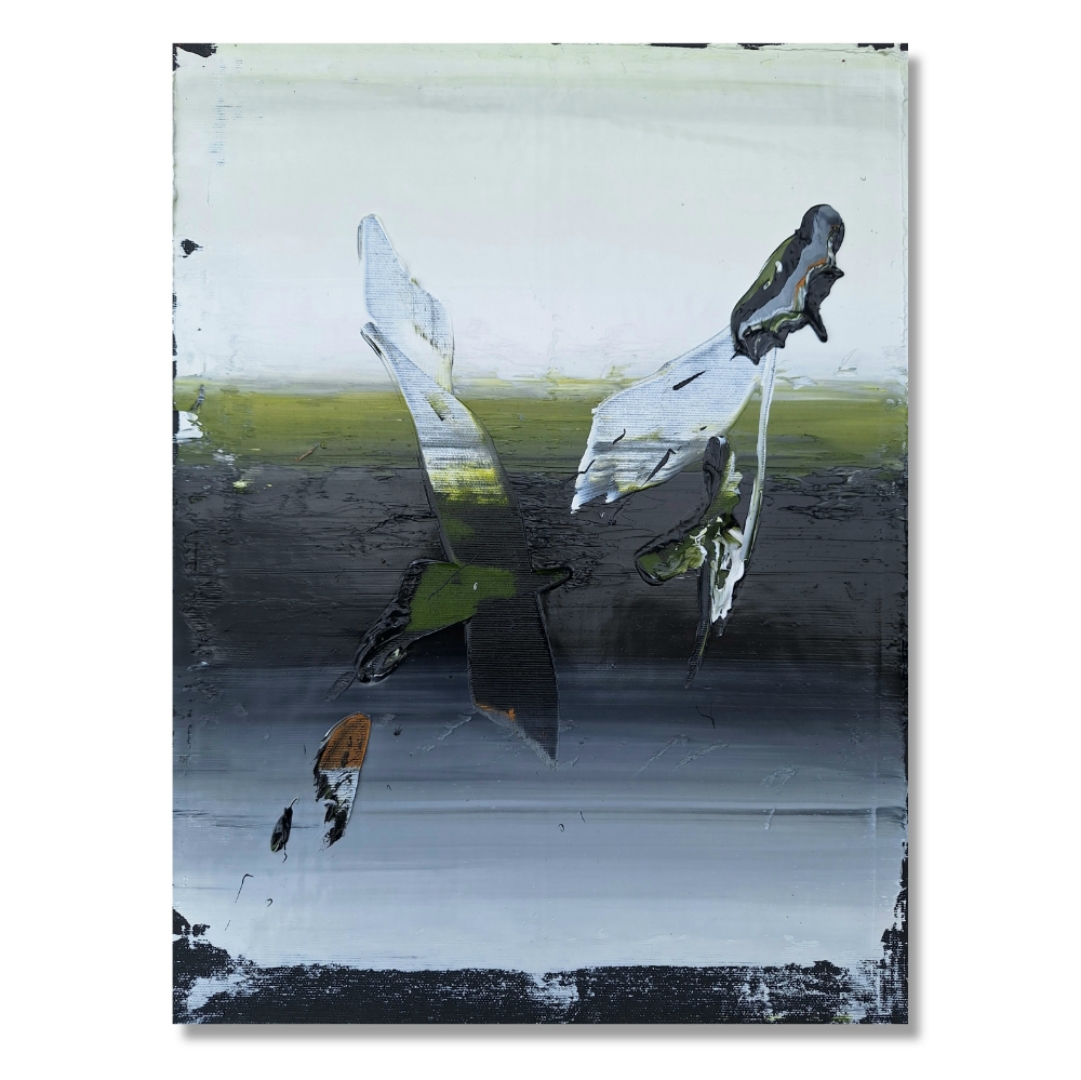
The “Golden Future” series reflects on themes of hope amidst crises like wars, natural disasters, and the pandemic. Can you elaborate on how you use layers and the process of scraping paint to convey these complex emotions and historical moments?
I began the “Golden Future” series in 2020, during the pandemic when people started reflecting on a future that needed to be better than the life they had before. Along with diseases, natural disasters and extreme weather events are becoming more frequent, leading to speculation about what changes are needed to slow them down. Simple things suddenly gained new value; people started to seek peace, comfort, and security. These events deeply influenced my work and subject choices. The “Golden Future” series captures only fragments of what I deemed important, initially painted realistically but later obscured by overpainting as everything continues to flow.

Your technique involves creating realistic portraits or still lifes and then painting over them with solid colors, which you later scrape off. Can you describe the emotional and conceptual significance of this method of creation, destruction, and revelation in your work?
The scraping process usually happens with my eyes nearly closed. I do not aim to reveal specific parts, leaving much of it to chance. That said, I only have one shot—if the uncovered area doesn’t work with the overall composition, the entire piece is ruined. While it may seem drastic, this approach lets me capture the impulse in my work. Transforming a fully finished realistic painting into something entirely abstract is often difficult and painful, almost like an act of vandalism or destruction. Yet, through this process, a new image emerges, one that contains a hidden mystery.
Your work often explores the instinct for preservation and the passage of time. How do you aim to engage viewers with these themes, and what reactions or reflections do you hope to provoke through the layered and fragmented nature of your paintings?
Abstract gradients over realistic motifs hold great significance for me. Symbolically, they represent the continuous flow of time. They are always drawn horizontally, often resembling a landscape you might see when traveling by high-speed train. I have been exploring this idea in my current series, entitled “German Landscape.” I select the tones for overpainting to align with those in the realistic motif. If a certain tone is prominent in the realistic layer, it will also dominate the abstract layer. These paintings often evoke thoughts or memories for me, with fragments appearing to float in the color/time flow, always anchored in the now. The intention is to spark reflection and allow the viewer to form their own interpretation, encouraging them to perceive their own time in a new light.

ARTIST OF THE MONTH
PAI32 EDITION’24
 PAI_32 platform