
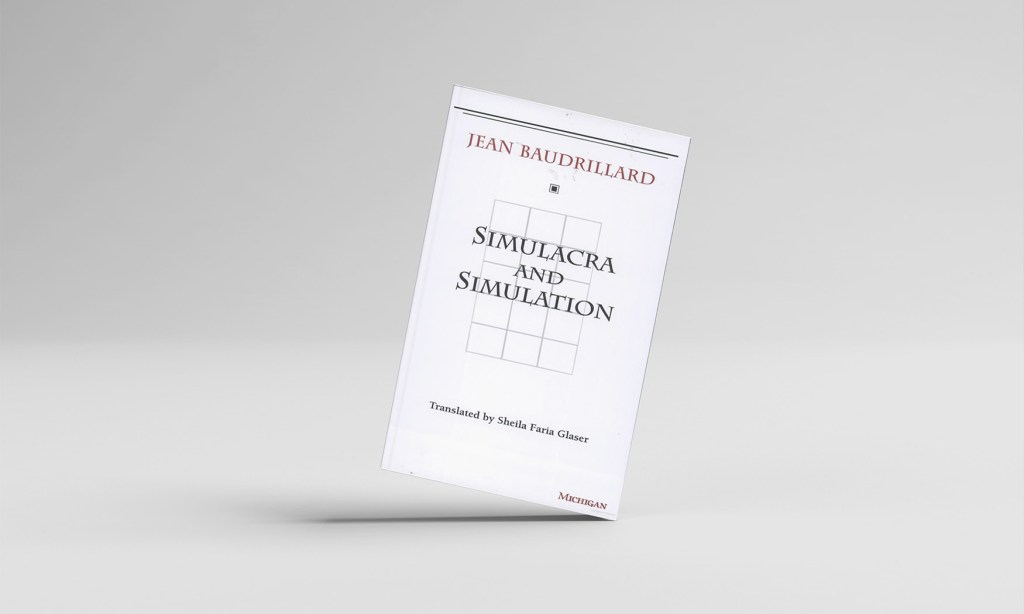
↑ Jean Baudrillard’s Simulacra and Simulation: A Critical Examination, Cultural Influence, and Its Connection to The Matrix.
Jean Baudrillard’s Simulacra and Simulation, first published in 1981, stands as one of the most influential and provocative texts in postmodern theory. In this work, Baudrillard challenges conventional notions of reality and representation, suggesting that in the contemporary world, reality has been replaced by signs and symbols that no longer have any connection to an actual referent. This concept, encapsulated in the ideas of simulacra and hyperreality, has had a profound influence not only on philosophy but also on art history and popular culture, notably influencing the creation of the iconic film The Matrix.
The Concepts of Simulacra and Hyperreality
At the heart of Baudrillard’s thesis are the concepts of simulacra and hyperreality. Simulacra are copies or representations of things that either no longer have an original or never had one to begin with. Baudrillard outlines a progression through four stages of simulacra: from a faithful copy of reality, to a perverted or distorted copy, to a copy that pretends to be a faithful copy but no longer corresponds to any reality, and finally, to a simulacrum that bears no relation to any reality whatsoever and becomes its own pure simulacrum.
Hyperreality, another key term in Baudrillard’s theory, describes a condition in which what is real and what is fiction are seamlessly blended together, creating a situation where there is no clear distinction between where one ends and the other begins. This results in a “reality” that is entirely constructed from signs and images, where simulations of reality become more real than the reality they simulate.

Influence on The Matrix
Baudrillard’s Simulacra and Simulation is famously linked to The Matrix, a 1999 science fiction film directed by the Wachowskis. The film explores a dystopian future in which humanity is unknowingly trapped inside a simulated reality, created by intelligent machines to subdue the human population while their bodies’ energy is harvested. The protagonist, Neo, discovers the truth and joins a rebellion against the machines to free humanity from this simulated reality.
The connection between The Matrix and Baudrillard’s work is not merely thematic but also literal; in one of the film’s key scenes, Neo hides his illegal software in a hollowed-out copy of Simulacra and Simulation. This book’s presence in the film is a direct nod to Baudrillard’s theories, suggesting that the world of The Matrix is an embodiment of hyperreality—where the simulation is indistinguishable from the “real” world.
Baudrillard’s exploration of a world where the distinction between the real and the artificial is blurred deeply influenced the conceptual underpinnings of The Matrix. The film’s central question—what is real?—echoes Baudrillard’s idea that in a hyperreal world, the line between reality and its representations is obliterated, leading to a world dominated by simulacra. However, it’s important to note that Baudrillard himself distanced his work from The Matrix, arguing that the film represented a misunderstanding of his ideas, particularly by simplifying the complex nature of simulation.
The Broader Cultural Influence of Simulacra and Simulation
Beyond its impact on The Matrix, Baudrillard’s Simulacra and Simulation has significantly influenced broader cultural and intellectual discourse. The book’s exploration of a reality dominated by signs and symbols resonates with the rise of digital media and the internet, where images, memes, and virtual experiences often overshadow physical reality. In this digital age, Baudrillard’s concept of hyperreality has become increasingly relevant, as the boundaries between the virtual and the real continue to blur.
In the realm of art history, Baudrillard’s ideas have resonated deeply, particularly in the analysis and creation of contemporary art. The notion that images and representations can become detached from any grounding in reality has been a pivotal idea in postmodern art, where the boundaries between reality and illusion are often deliberately blurred.
One of the most significant implications of Baudrillard’s theory for art history is the challenge it poses to traditional ideas of authenticity and originality. In a world of simulacra, the authenticity of a work of art is no longer tied to its relationship to reality, but rather to its place within a system of signs. This has opened up new possibilities for artists, who can engage with the concepts of simulation and hyperreality to explore themes of identity, perception, and the nature of reality itself.
The Legacy of Simulacra and Simulation
Simulacra and Simulation has left an indelible mark on both theoretical discourse and artistic practice. In the realm of art history, it has provided a framework for understanding how art interacts with and critiques the postmodern condition. By exposing the ways in which images and representations can become disconnected from reality, Baudrillard has influenced a generation of artists and thinkers who challenge viewers to reconsider their assumptions about the nature of reality and representation.
Moreover, Baudrillard’s work has become a cornerstone in the study of postmodernism, offering a critical lens through which to view the increasingly mediated and simulated nature of contemporary life. The book’s influence on popular culture, particularly through The Matrix, has further cemented its status as a seminal text. The Matrix not only brought Baudrillard’s ideas to a wider audience but also served as a cultural artifact that illustrates the very concepts of simulation and hyperreality that Baudrillard so incisively analyzed.
In conclusion, Jean Baudrillard’s Simulacra and Simulation is not only a seminal text in postmodern theory but also a key influence on contemporary art and culture. Its exploration of the dissolution of reality into a world of simulacra continues to challenge and inspire artists, filmmakers, and thinkers alike, making it an enduringly relevant work in the study of art, culture, and philosophy.
Book preview link.

Claire Bishop’s new book
Disordered Attention
 PAI_32 platform