

↑ Le chaos des echos lointains, Audiovisual work – Sound & Video, 3min, 2024
Dot Als is an artist at the forefront of exploring the ever-evolving relationship between technology and creativity. With a distinctive voice that merges digital innovation, organic aesthetics, and personal narrative, his work challenges conventional boundaries of art. From the sci-fi dystopian world of Le Chaos des Echos Lointains, where AI-generated lyrics converge with a fictional light-based religion, to the evocative audiovisual storytelling in Les Machines d’Acier, Dot Als uses cutting-edge tools to craft experiences that are both deeply conceptual and visually captivating.
Rooted in the dramatic landscapes of the French Alps and shaped by urban dystopian aesthetics, Dot Als draws from a rich palette of inspirations to create art that is as deeply personal as it is universally resonant. In his interview, Dot Als discuss the role of AI as both collaborator and disruptor, the challenges of staying relevant in a rapidly advancing creative landscape, and the personal philosophies that drive their practice forward.
Your recent audiovisual work, Le Chaos des Echos Lointains, blends sci-fi dystopian narratives with a fictional light-based religion, crafted using AI. How did the integration of AI tools influence your creative decisions, and what unique challenges did this technology present?
For Le Chaos des Echos Lointains, I used AI only specifically on the creation of the lyrics. I did it in 2 steps, first transferring my imagery into a short story, via a mix of GPT-4 and manual inputs. Then, I got GPT-4 to transform this story into lyrics of consistent style and length. This potentially wouldn’t work well for a project where lyrics are central, but for this work, I was mostly interested in the sound quality of french spoken words and their visual aspect (through the projected fonts in the CGI scenes), rather than by the actual story told by the lyrics.

Audiovisual work – Sound & Video, 3min, 2024

However in order to sculpt the sound and the visual aspect of spoken words, I needed material. In this case, I saw words as the rock material, which is then made into a shape with my own voice, light autotune, sound processing effects and with distorted/projected fonts in the video. Generally speaking I see two current uses for Generative AI, or ‘AI’, which I’ve both explored in different projects: Firstly, there is AI is a “medium”. That’s something I’ve explored with one project called Les Machines d’Acier. In this work not only AI was used to generate the lyrics, but also to deliver them vocally. On top of that, the visual delivery was heavily and explicitly AI generated.
Secondly, there is AI as an artist ‘assistant’. And here it’s actually not very different from an artist having a few junior human assistants, who’d be able to do a lot of things and have lots of knowledge in different fields, but at the same time would do a lot of mistakes, struggle to produce high quality original work; and also couldn’t be fully trusted to represent your artistic direction. These assistants need good briefs and need their work to be checked and corrected. Nevertheless, on the technical side, they can bring ideas to solve problems quickly, like solving a 3D-related error in Blender in five minutes instead of one hour. And they can automate some of the boring and less important parts of your art process you’re not so interested in, as well as the technical and admin side around it.
This of course comes with ethical concerns such as energy consumption, bias and the fact that it disincentivises people to produce quality content, not just related to art but also technical answers on forums etc. On top of that, it contributes to flooding the internet with ever more poor quality outputs, which makes original art harder to find and sometimes even harder to appreciate. It will be interesting to see the ways humans find to mitigate these issues over time, ideally sooner than later.
Finally, things are moving very fast and I think they will continue to create high level of disruption for several years, in ways that I would struggle to predict. At the moment it’s pretty crazy; you could go on a six month hiatus and come back to discover that your practice has become near obsolete and low value – both in terms of artistic interest and value creation. I feel this may actually be what’s about to happen for me in regard to my 3D skills, particularly for very short animations and live visuals. Sometimes it worries me, but also I’m excited because I tend to be fairly adaptable and I get ideas easily so I’m hoping I will manage to keep my practice interesting, by surfing the wave of disruption, rather than sinking under it.

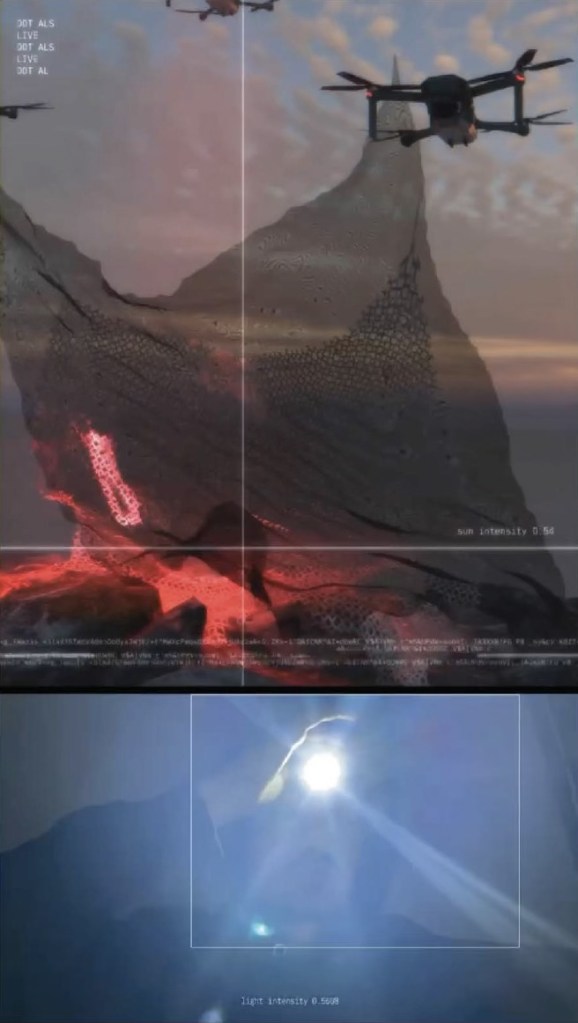
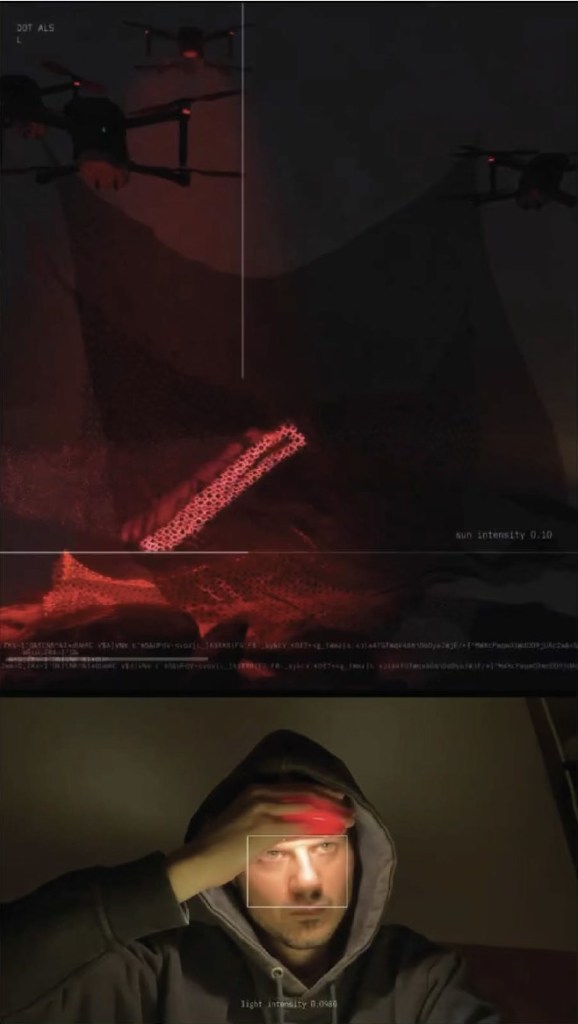

You’ve described your childhood in the French Alps as a key influence on your artistic identity. In what ways has this natural environment shaped your exploration of the intersection between digital and organic aesthetics in your work?
It’s something I’m only starting to explore more and more consciously, how much being in such a dramatic and scenic natural environment has impacted me. I think it impacted my appreciation of lighting because of the reflection of light on the lake, plus all the crazy different combinations brought by light bouncing on the mountains, which also become snowy in winter, then also adding diffusion and considerable brightness. I was exposed to insane lighting.
I didn’t travel much and watched very little cinema until I was 23. I was much more focused on the music scenes then. So then when I moved to London at 24, I got suddenly exposed to the urban and associated dystopian aesthetics. Then of course, movies and media played a role too, but it’s not the same as observing things in real life. Then over time, both images were always present in my mind and therefore mixing them regularly in my work just feels intuitive and relevant.

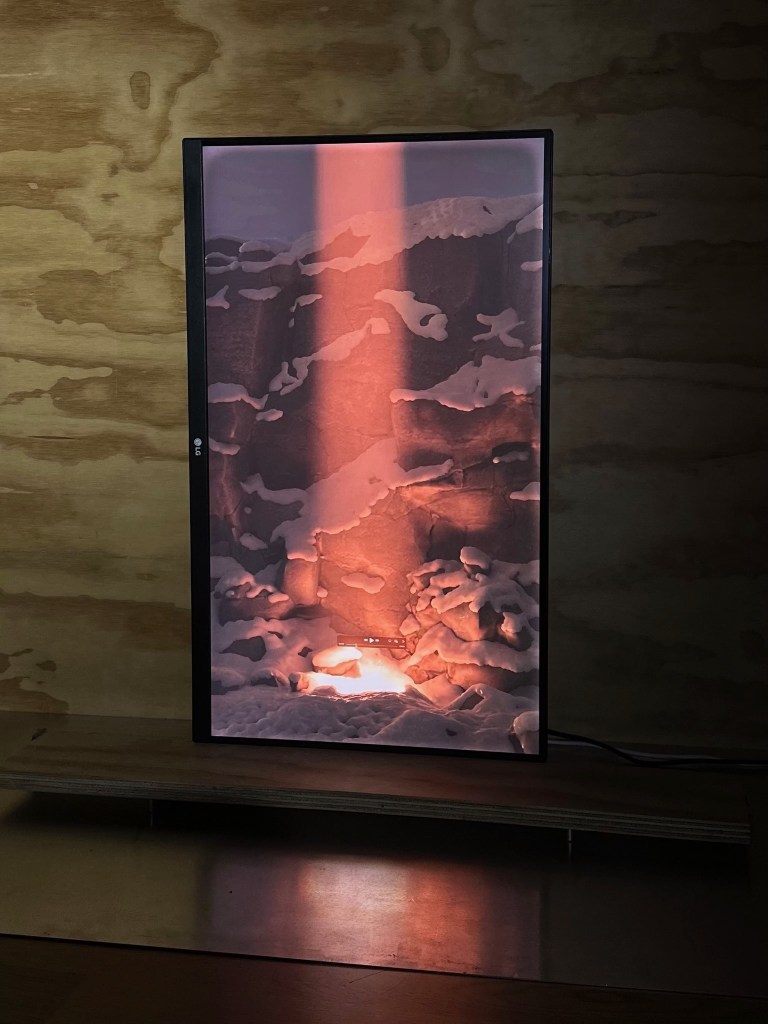
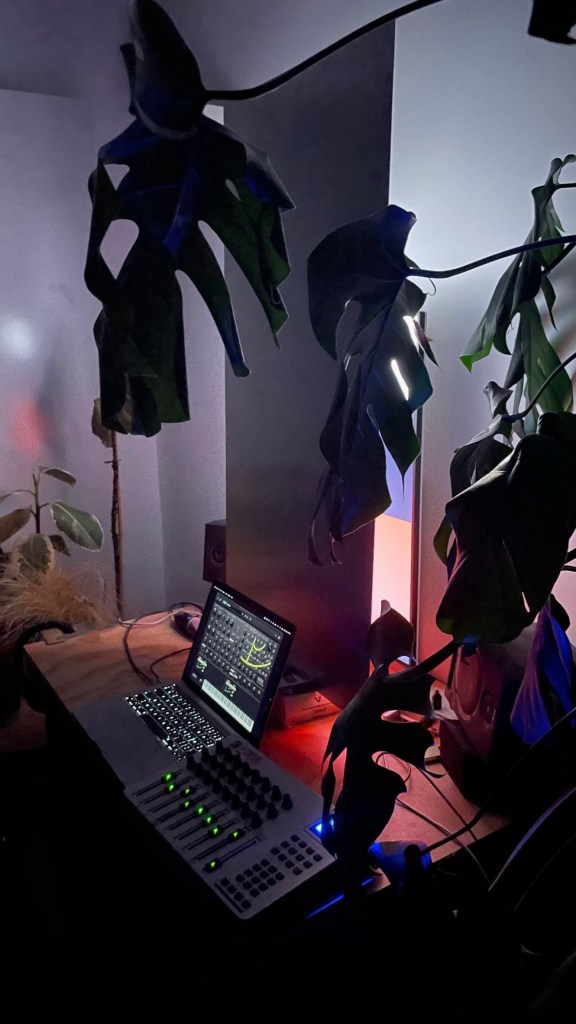
Your portfolio showcases a remarkable versatility, spanning interactive installations like Luminous Resonances and live performances at venues such as Cafe OTO. How do you approach the creative process when designing for such diverse formats, and how does the audience’s interaction influence the final result?
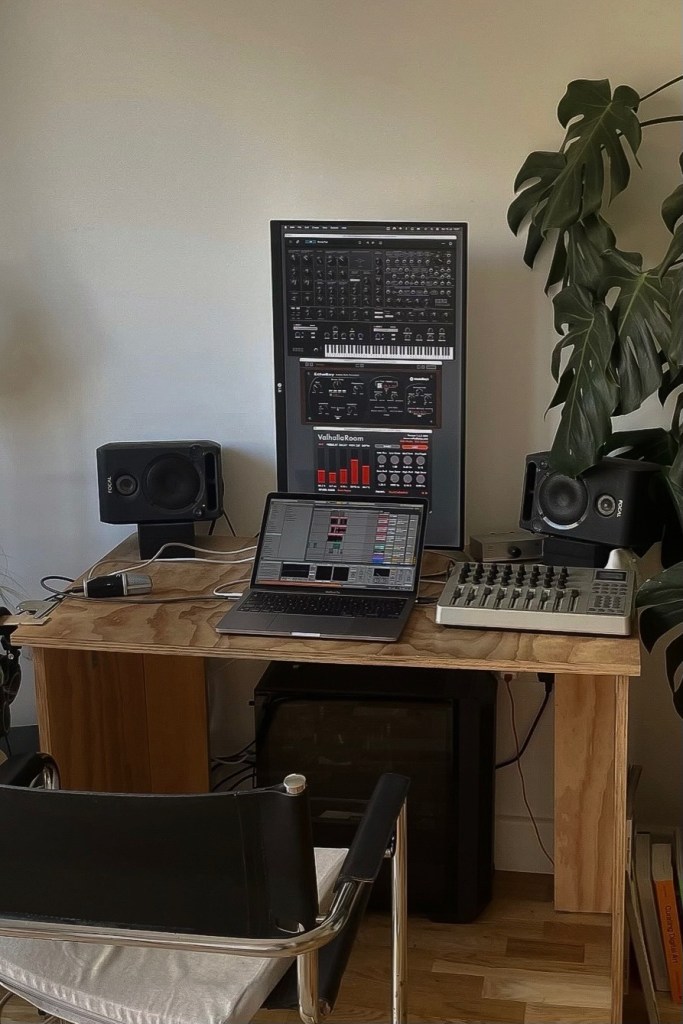
I have lots of ideas most of the time which I tend to document in one massive note on my iPhone. Often I would start projects by first starting the sound aspect of things. Once I have a rough draft of audio, I may move to the other elements, such as drafting a CGI scene in Blender and then it’s back and forth between mediums. I tend to progress on both audio and visual aspects at the same time. It’s also needed because 3D rendering can be a frustratingly slow process and that way I can continue working on a project while another aspect gets blocked.
Generally, as I’m progressing on a project, I will discover things and start having ideas for the next one. Then I will move to the next project, which is already in the back of my mind, even if it’’s a very rough idea. I tend to work on one project at a time to not be too overwhelmed, because the amount of things to think about within one project can already be at the very limit of overwhelming my brain. Le Chaos des Echos Lointains was particularly ambitious in that sense because I had to think about the music, the vocals, the CGI scene, lighting, character animation, lights animation, cameras and of course the general aesthetics of the scene. Regarding audiences, originally, I tended to be my biggest audience, but something I’ve discovered is that making art for one person can be a bit limiting. It’s rewarding in regards to the fact that I love it, but it’s not rewarding when it doesn’t allow you to connect with anybody or can’t reach anybody because the medium doesn’t allow it. e.g. if the format is a 10x1000px video work, it may be great but it may be hard to push it through any existing digital platforms.
Now I tend to think about both myself and ensuring that what I’m doing is not just a private thing that nobody can appreciate unless they have exactly the same references and tastes as me. That being said, all my work is still highly personal.


Your single Les Machines d’Acier marks an evolution in your musical storytelling. What themes or emotions did you aim to convey through this track, and how does it connect to the broader narrative of your audiovisual creations?
Les Machines d’Acier followed a process that was very unusual to me. Generally I avoid going back to my old work, but in that case, I started to rework the instrumental of a track I had made around 2018-19, which I liked but didn’t quite manage to finish then. Around the same time, I became aware of this crazy AI to make still portrait images move as if they ‘speak’, and how I could marry these to AI generated lyrics and AI synthetic voices to form a coherent A/V work.
So this project became both about exploring AI in depth as well as giving life to a track I liked which would have otherwise never seen the light of day. Usually I would have edited this in Premiere Pro, but there I decided to use Touchdesigner to assemble the audio and visuals in a more dynamic and playful way, also allowing me to add generative shapes and text on top of it to reinforce the aesthetics even more. At the time, I was also building it as something I could potentially re-use as part of a longer performance later.
I guess one evolution that this project brought to my creations in general was to show me how bringing french spoken words to my A/V work could add an interesting layer to the existing aesthetic, both by adding a human touch to it, despite being AI-generated in this work, as well as its acoustic quality.

Short video with audio, 1 min
1080x1920px, 2023

Short video with audio, 1 min
1080x1920px, 2023
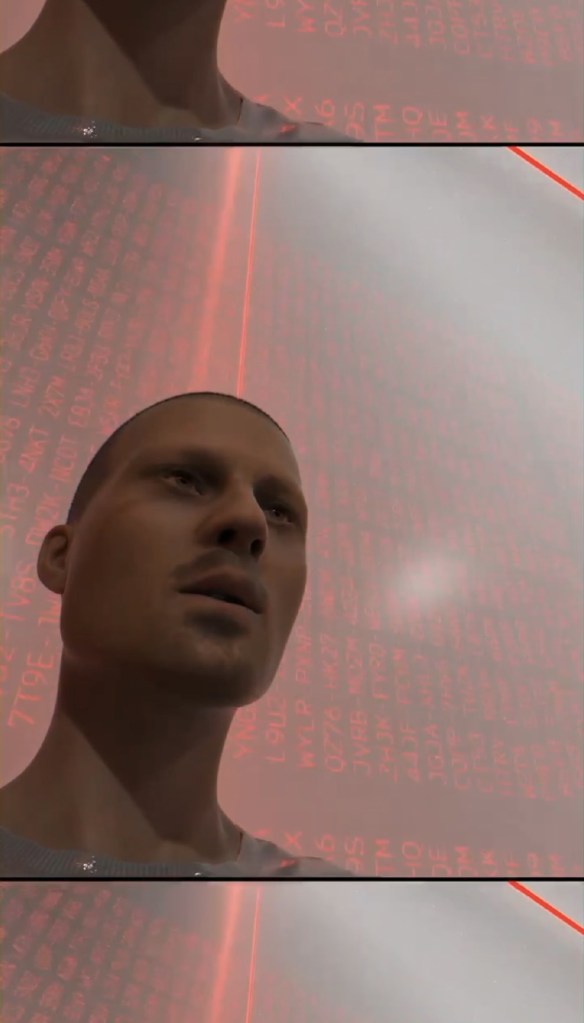
Short video with audio, 1 min
1080x1920px, 2023
What do you think is the primary idea or goal of art in general? If there is a specific goal, what would it be?
I think art has different primary goals for different people. I’m aware of some, and probably unaware of others. For example, for some, art may primarily be political, for others it may be a way to strengthen and/or express their identity. For some it may fulfil a need to belong and/or contribute to a movement, subculture and its community. For others it may be a necessary healing process.
“The good thing is that the same art can fulfil many goals for many different people, some intended by the artist, some unintended.” – Dot Als
For me personally, I think it tends to be about a need to express myself and my identity, while also giving some sort of meaning to my life. I also believe it has a role to play in connecting me with people.
Around 2017, I went through a phase of doubt about my ability to ever connect with an audience and I went through a 9 months break of doing any sort of art. What I’ve experienced then is that I started to loose my sense of identity and self worth, and felt a loss of meaning. Then I went for an incredible three days week-end in Berlin with three friends which massively energised and re-inspired me. Coming back, I decided to restart working on my art practice. Since then I never stopped again.
Dot Als website
ARTIST OF THE MONTH
Interview, Online Exhibition,
your Art in AOM’25 Book

ARTIST OF THE MONTH
PAI32 EDITION’24
 PAI_32 platform