
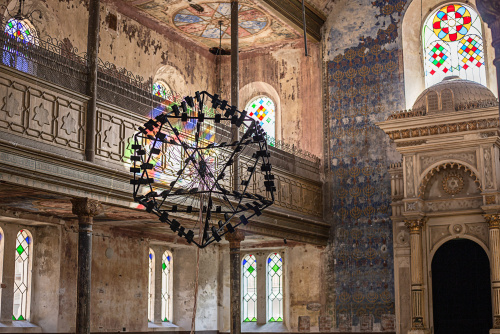
↑ Heat 4 Speed, 2024 > stainless steel, glass, crude oil, fuel, (detail)
Mário Birmon is an innovative artist whose work delves into the dynamic interplay between technology and human experience. His diverse portfolio encompasses projects such as Heat 4 Speed,Garden of Eden, and Ghost in the Shell, each reflecting a unique exploration of contemporary themes. Birmon’s participation in exhibitions like Heuristic Algorithm at Prague’s Pragovka Gallery further underscores his commitment to engaging with complex concepts.
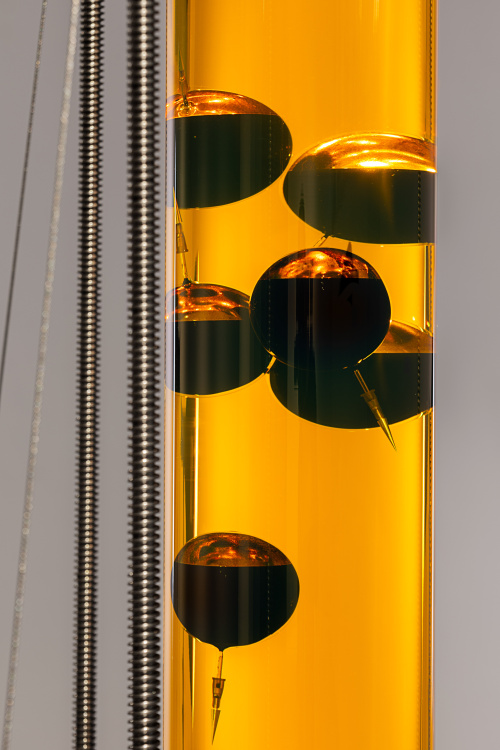


Your work often dives into complex and futuristic themes, like in your recent piece Heat 4 Speed. What drew you to explore ideas like speed and transformation, and how do you translate such dynamic concepts into visual art?
The complex and continuous process of globalisation and streamlining of the processes of transfer of commodities based on the satisfaction of customer needs carries with it more and more consequences of destruction on the environment. This aesthetics of the destruction of movement fascinates me. The very process of acceleration – of speed and transformation – is what I set out to create in the aforementioned Heat 4 Speed object. The object – thermometer in this case becomes an apparatus for measuring these processes and changes reflected in the temperature of the environment. It is incredible how oil pulled from its liquid grave has helped in this process of acceleration from the Holocene to the Anthropocene.
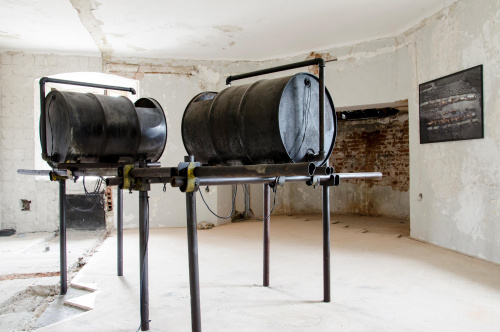

In projects like Garden of Eden and Ghost in the Shell, you’ve tackled a wide range of themes. How do you decide what stories or ideas to explore in your art, and is there a common thread that connects your work?
I have the feeling that thematically I am more or less still spinning in the previously mentioned topics such as movement and acceleration and their impacts on the environment. The fascination with destruction, whether caused by the consequences of human activity or by nature, led me to elaborate on these themes, which of course led to further conclusions and conclusions, both in the creation and in the elaboration of the problem. In my photographic practice, I try to use layers to express the issue, which refer to further quotation of the image itself, but also to the themes that I address in it.

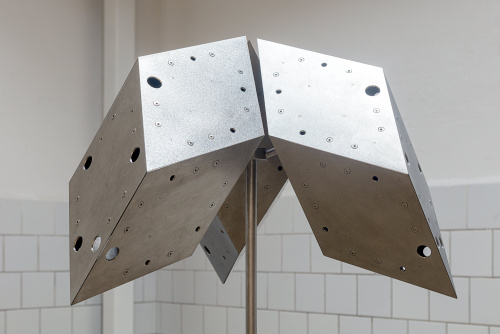

You’re part of the group exhibition Heuristic Algorithm at Pragovka Gallery, which centers on creative problem-solving. What was your experience contributing to this theme, and how do collaborations like this shape your perspective as an artist?
The group exhibition Heuristic Algorithm in Pragovka Gallery under the curatorial leadership of Pavel Tichon left in me a very positive experience of cooperation with other talented artists, whose research of diverse themes and issues led to very interesting conclusions. I think it was possible to exhibit an interesting set of works that offered creative approaches and solutions. This collaboration on a common visual concept can shape further directions, which is to some extent what is happening in this case. I definitely want to continue to be part of similar group projects whose strong potential enriches my further work as an artist.
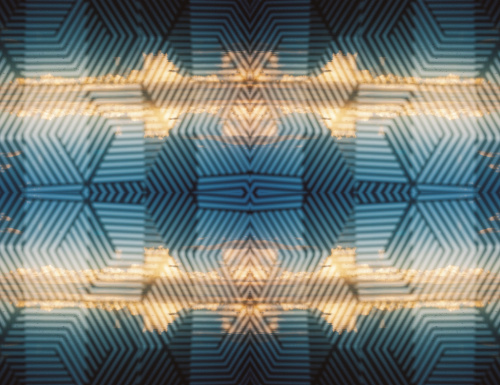


When you think about the future of your work, are there any particular themes, techniques, or mediums you’re excited to explore next?
The topics that I deal with have developed either from direct experience and experience in the field or through the study of specific issues. They are continuously intertwined and superimposed on each other. I definitely want to continue this fluidity, to elaborate as much as possible on what has already been started and, of course, to discover more. As far as the new medium is concerned, I want to start working on sound installation and video in the near future, where I see a strong potential in the following projects that I am currently working on.


What do you think is the primary idea or goal of art in general? If there is a specific goal, what would it be?
We live in a wonderful and at the same time difficult time when man or humanity is at a certain milestone and has to choose which direction to take. In such a fateful point, in my opinion, the primary task of the artist is to convey to the viewer a true and honest view of things and situations which, perhaps, are difficult to see in a time of huge layers of information or hoaxes. I am extremely grateful to be able to live and work in this time.


Mário Birmon website

ARTIST OF THE MONTH
Interview, Online Exhibition,
your Art in AOM’25 Premier Book

ARTIST OF THE MONTH
PAI32 EDITION’24
 PAI_32 platform