
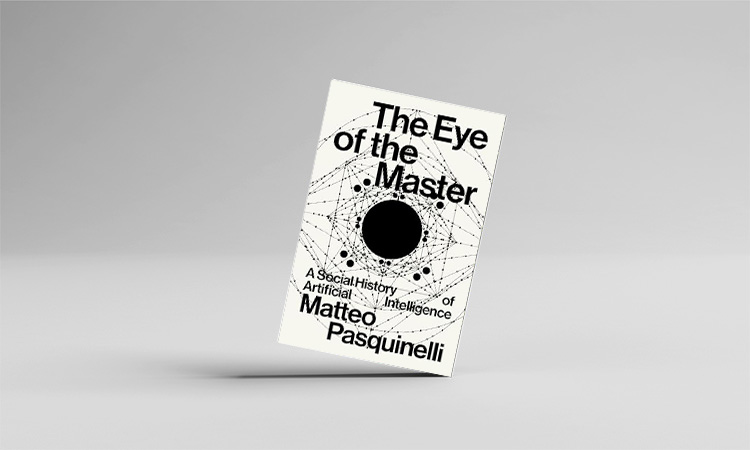
In The Eye of the Master: A Social History of Artificial Intelligence (Verso, 2023), Matteo Pasquinelli offers a compelling critique of AI, challenging the conventional narrative that views AI as a mere technological advancement. Instead, Pasquinelli posits that AI is deeply rooted in the historical development of labor and social relations.
“There will be a day in the future when current AI will be considered an archaism, one technical fossil to study among others.”— Matteo Pasquinelli, The Eye of the Master (Verso, 2023)
Labor as the Foundation of Intelligence
Pasquinelli introduces the concept of the “labor theory of automation,” suggesting that AI systems are designed based on the division of labor and collective knowledge. He asserts, “Labour is the first algorithm,” emphasising that algorithmic thinking has always been a social process emerging from collective practices and material interactions with tools and environments, rather than solely from individual mental computation.
Machines as Social Constructs
The book delves into how technological innovations, from textile looms to computing engines, have consistently been developed by observing and systematizing workers’ movements and cognitive processes. Pasquinelli notes, “The invention of all those machines by which labour is so much facilitated and abridged seems to have been originally owing to the division of labour,” highlighting that machines emerge by observing collective work patterns and that technological design reflects social organisation.
“What is AI? A dominant view describes it as the quest ‘to solve intelligence’ – a solution supposedly to be found in the secret logic of the mind or in the deep physiology of the brain, such as in its complex neural networks. … I argue, to the contrary, that the inner code of AI is shaped not by the imitation of biological intelligence, but by the intelligence of labour and social relations.”— Matteo Pasquinelli, The Eye of the Master (Verso, 2023)
AI and Social Hierarchies
Pasquinelli argues that AI systems automate tasks traditionally performed by humans, questioning the future of work. He states, “The project of AI has emerged from the automation of the psychometrics of labour and social behaviours,” underscoring that AI reflects the intelligence of labor and social relations, not just human cognition.
“As any word implies a grammar, any number hides an algorithm – that is, a procedure for representing quantities and for performing operations with quantities. … All numbers are algorithmic numbers as they are manufactured by those algorithms that are the systems of numerations.”— Matteo Pasquinelli, The Eye of the Master (Verso, 2023)
Reframing AI’s Purpose
Challenging the dominant view that AI seeks to replicate human intelligence, Pasquinelli contends, “What is AI? A dominant view describes it as the quest ‘to solve intelligence’ – a solution supposedly to be found in the secret logic of the mind or in the deep physiology of the brain… In this book I argue, to the contrary, that the inner code of AI is constituted not by the imitation of biological intelligence but by the intelligence of labour and social relations.”
 PAI_32 platform