
When Sound Becomes a Lifeline
How Marco Barotti’s Coral Sonic Resilience is using underwater sculpture and acoustic ecology to coax dying reefs back from the brink
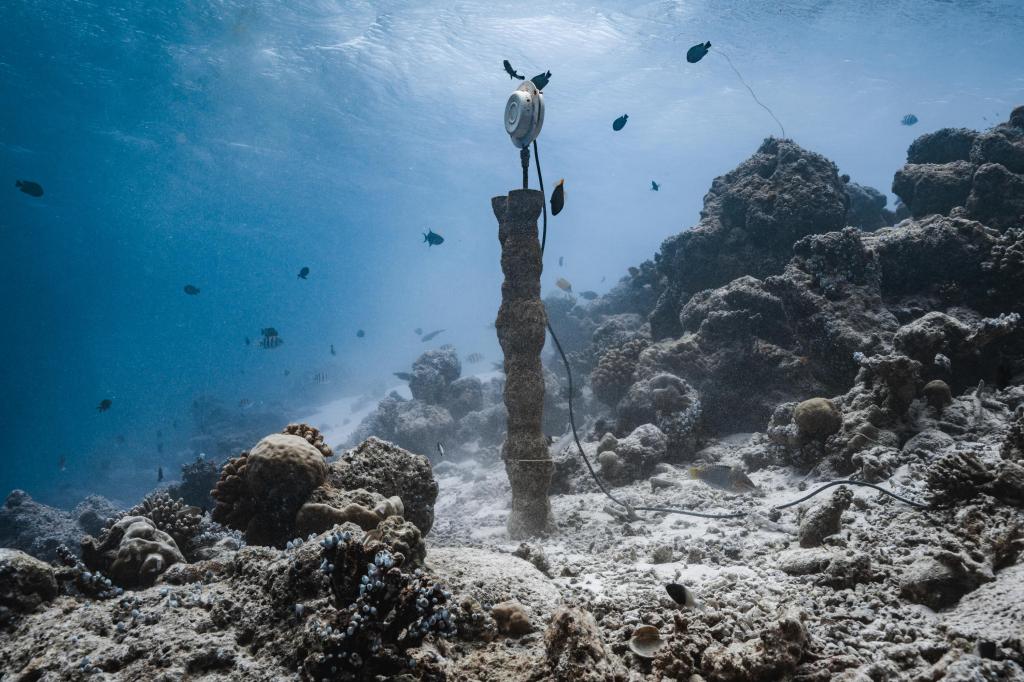
Somewhere beneath the surface of the Indian Ocean, off the shores of a small Maldivian island called Feridhoo, a reef is listening. It is not listening to the roar of speedboats or the muffled noise of a planet in crisis — it is listening to itself, to the memory of what it once was. And in doing so, it may just survive.
The ocean has always had a voice. A healthy coral reef is not the silent, ethereal landscape of tourist postcards — it is a riot of sound. The snap and crackle of pistol shrimp, the low percussion of parrotfish, the high-frequency chatter of wrasse and damselfish: together they compose one of nature’s most complex soundscapes. When a reef bleaches and dies, this acoustic tapestry falls silent. And in that silence, recovery becomes even harder — because sound, it turns out, is precisely what attracts new life.
This is the insight at the heart of Coral Sonic Resilience, a project by Italian-born, Berlin-based multimedia artist Marco Barotti that sits at one of the most unexpected intersections in contemporary art: acoustic ecology, marine biology, and environmental activism — wrapped in the form of sculpture.
The Science Behind the Song
The scientific foundation for the project comes from research by Professor Timothy Lamont of Lancaster University, who demonstrated in 2022 that playing recordings of thriving coral reefs at degraded sites actively draws fish larvae and other marine organisms back to those locations — a technique he called “Acoustic Enrichment.” Healthy reefs, Lamont showed, emit distinct sonic signatures that serve as beacons, guiding the juvenile creatures that colonise, rebuild, and sustain these ecosystems.
For Barotti, this discovery was not merely academic. He had already been exploring the metaphorical territory of coral bleaching through an earlier data-driven sound installation titled CORALS, developed with the Science Gallery Berlin and the Technische Universität Berlin. That work used datasets from NASA, NOAA, and Copernicus, feeding them into algorithms trained on shamanistic music traditions, to create what Barotti calls “Techno Shamans” — speculative healing rituals for global reefs. When he learned that Lamont was applying, through rigorous science, something conceptually similar to what he had been exploring through art, the path forward became clear.
I discovered that a marine biologist was actively applying, through science, what my conceptual, speculative artwork sought to metaphorically explore. His research became the inspiration for Coral Sonic Resilience.
Marco Barotti
Sculptures That Speak Underwater
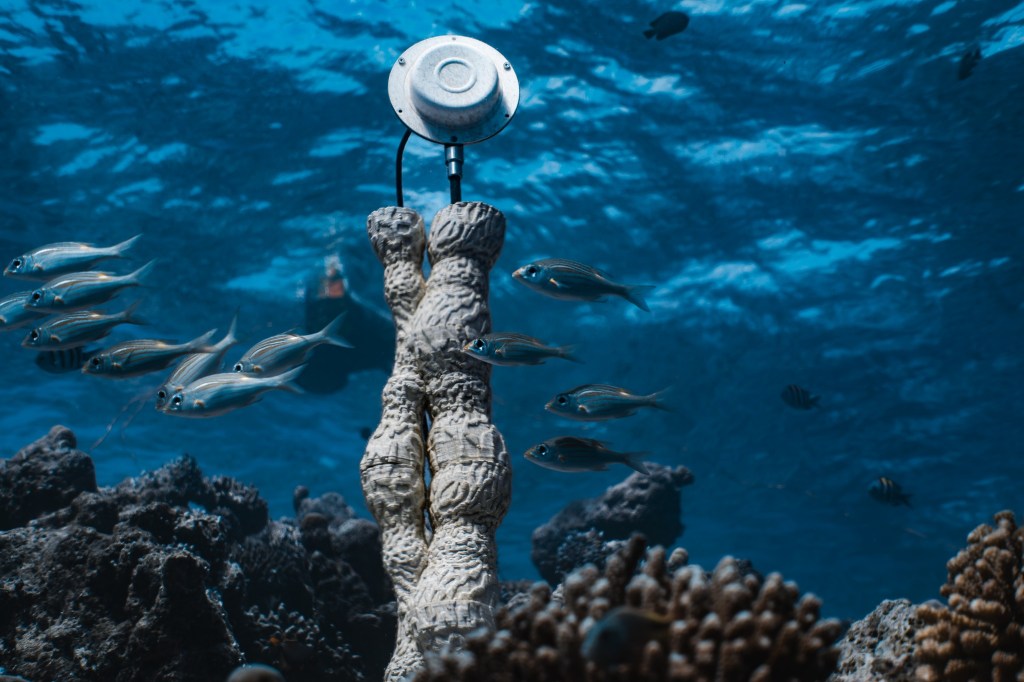
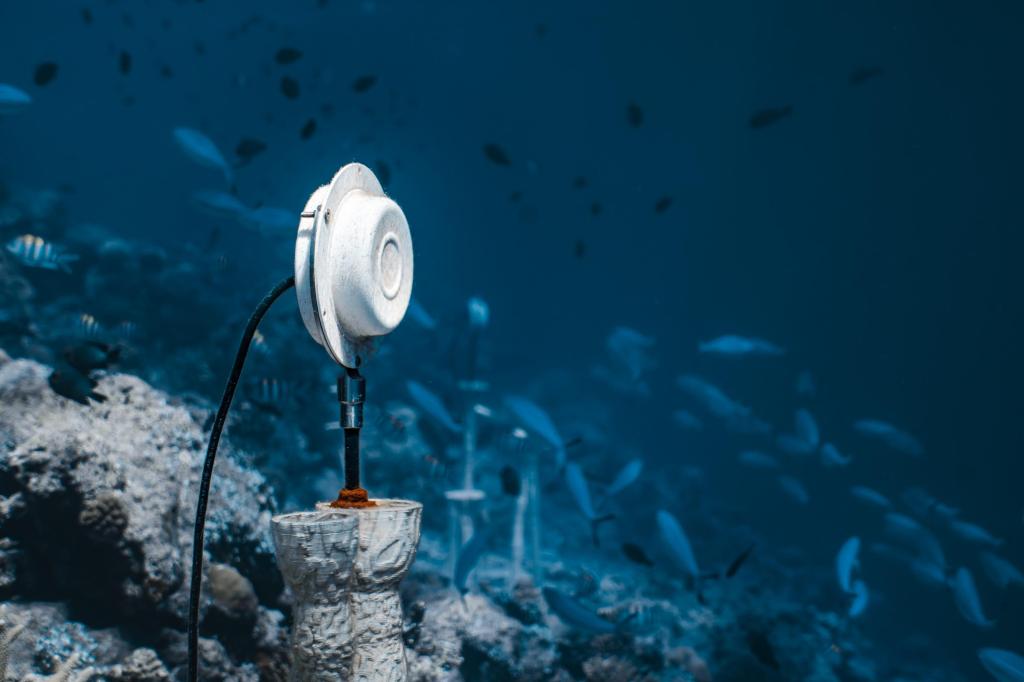
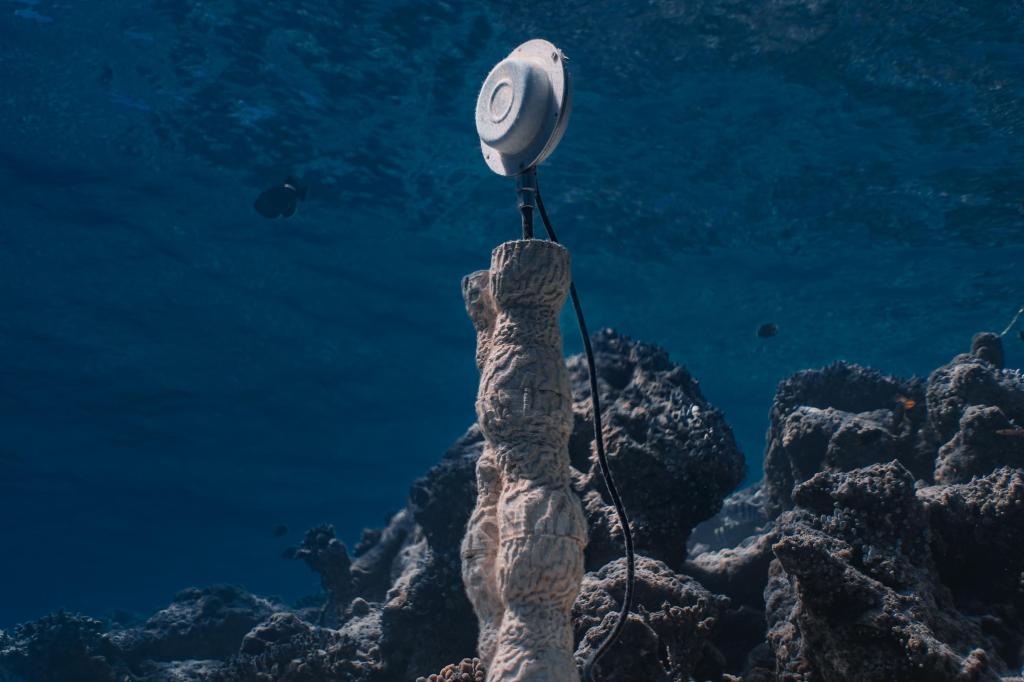
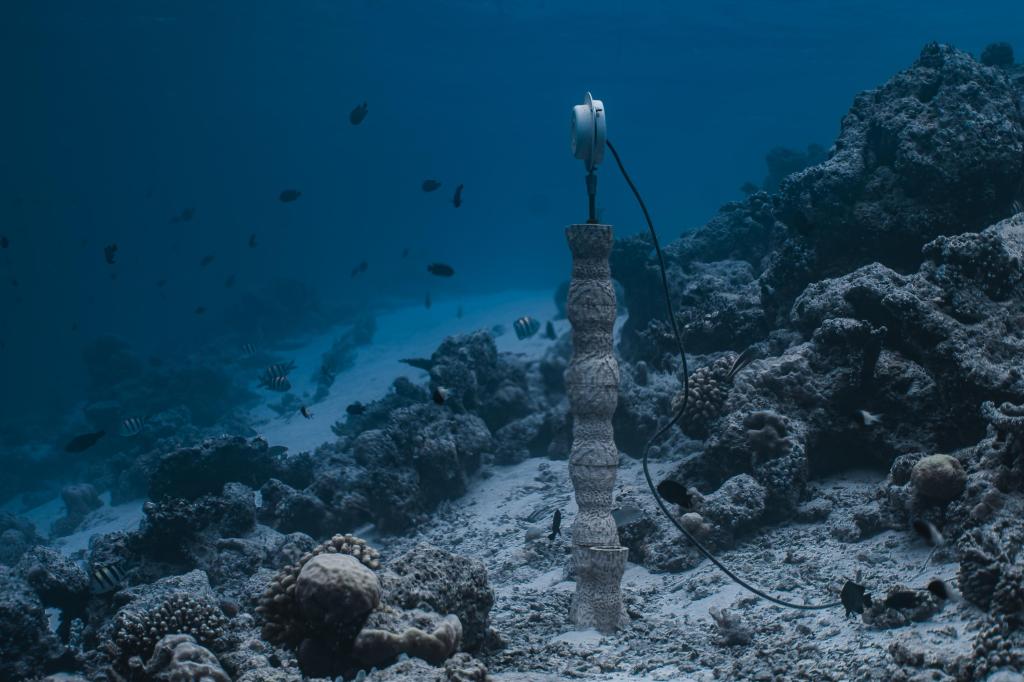
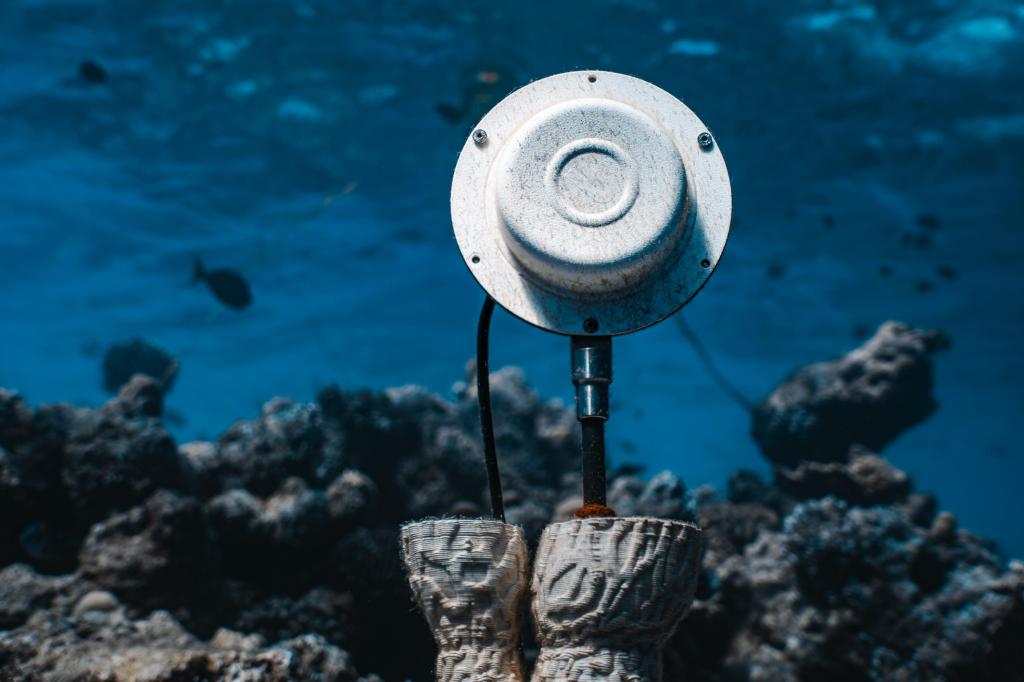
What Barotti has built in response is both scientifically purposeful and visually extraordinary. A series of underwater sculptures, 3D-printed using ceramics and calcium carbonate — materials whose composition closely mirrors that of coral itself — are deployed on the seabed around Feridhoo Island. Their forms are derived from 3D scans of bleached corals: ghostly, porous structures designed not only to emit sound but to function as physical habitat, inviting marine life to settle, shelter, and grow across their surfaces.
The sound they emit is no ambient approximation. Barotti’s team, together with Prof. Marco Patruno and Antonio Beggiato from the BCA Faculty of the University of Padova, ventured into the open ocean to make professional-grade recordings of living reefs — diving through strong underwater currents to capture soundscapes that the team described as feeling like being inside an invisible subway. These recordings are fed continuously through underwater loudspeakers powered by custom-designed floating solar buoys, completing an installation that is, from end to end, entirely renewable-energy powered.
Art That Does the Work
It would be easy to read Coral Sonic Resilience as an art project that merely borrows the language of science for aesthetic credibility. It is not. The installation is rigorously monitored: coral growth rates are measured, fish population surveys are conducted, and acoustic data is collected before and after deployment to assess the actual impact of the soundscapes. The sculptures are designed to remain submerged until the reef recovers — at which point the speakers and solar buoys can be relocated to another struggling site. The technology, if proven, is meant to be shared.
That practical ambition distinguishes this work from most environmental art, which can risk becoming a form of elegiac contemplation — mourning the loss of nature from a safe aesthetic distance. Barotti is attempting something more uncomfortable and more necessary: to make art that intervenes directly, that places itself in the ocean and waits, monitoring, listening, broadcasting the sound of life to places where life is failing.
The project brings together the Coral Restoration Project Feridhoo, the University of Padova, the Feridhoo Island Council, the audio specialists at Relaxound, acoustic ecologist Timothy Lamont, and the European S+T+ARTS programme — spanning art, science, engineering, and indigenous island governance in a collaboration that is as structurally ambitious as it is ecologically urgent.
Sound as Ecological Care
There is a philosophical dimension to this project that deserves attention. Barotti frames listening — not as a passive act of reception, but as an act of ecological care. In an era characterised by the overwhelming visual noise of climate crisis imagery — the bleached atoll, the melting glacier, the burning forest — there is something quietly radical about an art that asks us to use a different sense, to attend to what the ocean sounds like, what it used to sound like, and what it could sound like again.
The immersive exhibitions planned for 2026 — at ZKM Karlsruhe, Science Gallery Melbourne, and Art Laboratory Berlin, as well as an already-opened show at CONTRAST Gallery in Tokyo — will bring these underwater soundscapes to landlocked audiences. They will offer the public access to an environment most people will never physically enter, and in doing so, ask them to form a sensory and emotional relationship with a world they are helping to destroy and must help to restore.
A New Model for Art and Science
Marco Barotti — Tuscan-born, trained at the Siena Jazz Academy, now working from Berlin — has spent his career crafting kinetic sound sculptures assembled from audio technology, consumer electronics, and waste materials that mimic the behaviours of animals and plants. He has been recognised with the NTU Global Digital Art Prize, the Tesla Award, and grants from S+T+ARTS, among others. But Coral Sonic Resilience feels like the fullest expression yet of his practice: a work in which the art is not about the crisis, but in active dialogue with it.
The deeper implication is this: that art is not merely useful for raising awareness, the modest and rather exhausted ambition of so much contemporary environmental work. It can be useful for the environment itself. A sculpture that gives a reef something to listen to, a surface to grow on, and a reason to attract new inhabitants is not a metaphor. It is infrastructure.
The reef off Feridhoo is listening. For once, what it hears might make a difference.
Find out more at marcobarotti.com/Coral-Sonic-Resilience
 PAI_32 platform