
FRIEZE LONDON 2026: THE BODY, TECHNOLOGY AND THE CHANGING CONDITIONS OF CONTEMPORARY ART
14–18 October 2026 | The Regent’s Park, London
From digital bodies and artificial intimacy to feminist interventions and the politics of everyday objects, Frieze London 2026 offers a compelling picture of contemporary art negotiating an increasingly unstable world.
Frieze London returns to The Regent’s Park this October, bringing together 172 galleries from 42 countries and regions. Alongside internationally established names, the fair places a particular emphasis on emerging artistic practices, experimental installations and new approaches to contemporary culture.
This year’s edition introduces The Code Universe, curated by Carol Yinghua Lu, alongside the returning Focus and Artist-to-Artist sections. Together, these programmes position discovery at the centre of the fair, encouraging encounters between established artistic languages and a younger generation exploring technology, identity, materiality and social transformation.
Beyond the familiar rhythms of the international art market, some of the most interesting presentations challenge the traditional relationship between an artwork, its audience and the space in which it exists.
ARTWORKS THAT CAUGHT OUR ATTENTION
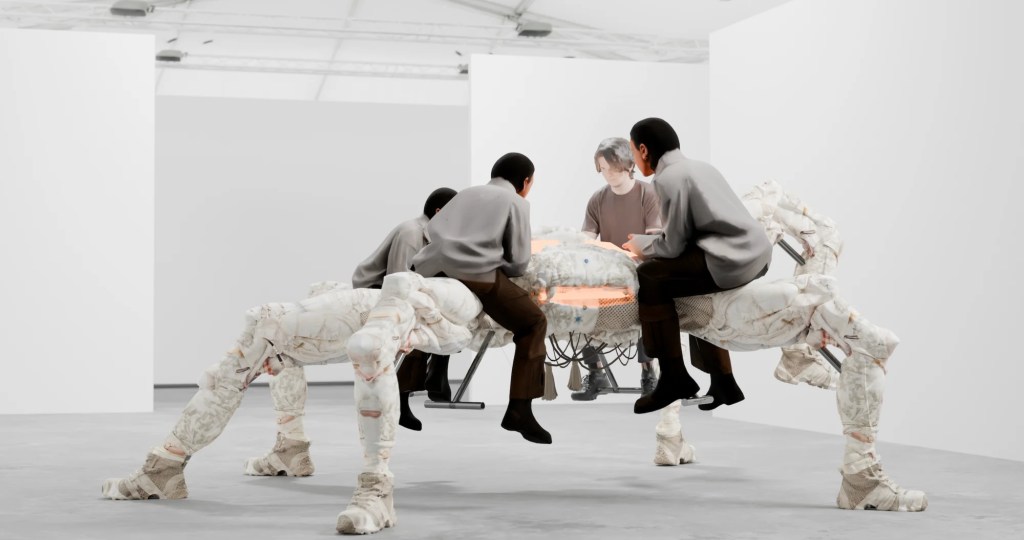
Theo Triantafyllidis — Feral Metaverse (Spider), 2026
Frieze Artist Award | P1
The boundary between physical and virtual experience becomes unstable in Theo Triantafyllidis’s Feral Metaverse (Spider), winner of the 2026 Frieze Artist Award.
Taking the form of a giant interactive spider, the installation connects a climbable physical sculpture to a shared digital environment. Participants collaborate to generate temporary collective bodies, questioning where individual agency ends and collective identity begins.
Rather than treating the virtual world as an escape from material reality, Triantafyllidis proposes a space where digital interaction becomes an embodied, social experience.
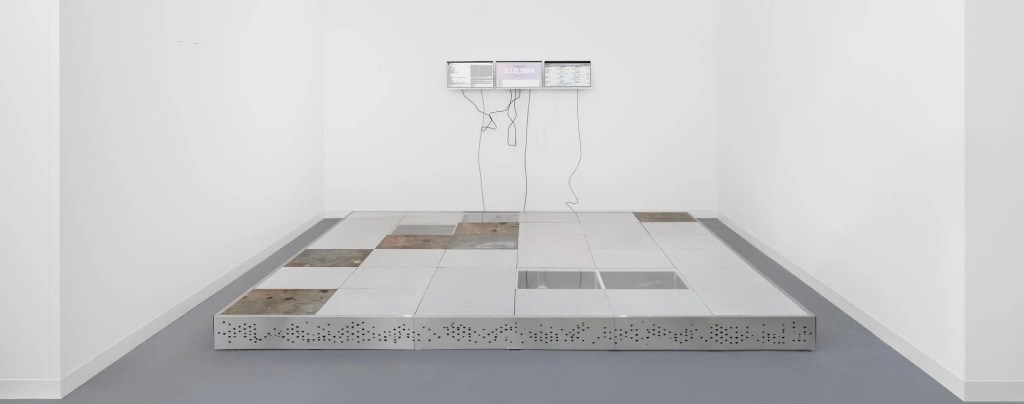
Ella Fleck — Training Material, 2026
Ehrlich Steinberg | Focus, F30
Artificial intimacy, digital labour and commercialised desire converge in Ella Fleck’s Training Material.
The installation uses directional sound and physical vibrations, with male voices reading scripts associated with intermediaries who manage conversations on subscription-based adult platforms.
By exposing the mechanisms through which intimacy is scripted, performed and sold, Fleck investigates the increasingly uncertain distinction between human connection and manufactured emotional exchange.
The work speaks directly to a contemporary environment in which desire can be outsourced, simulated and monetised.
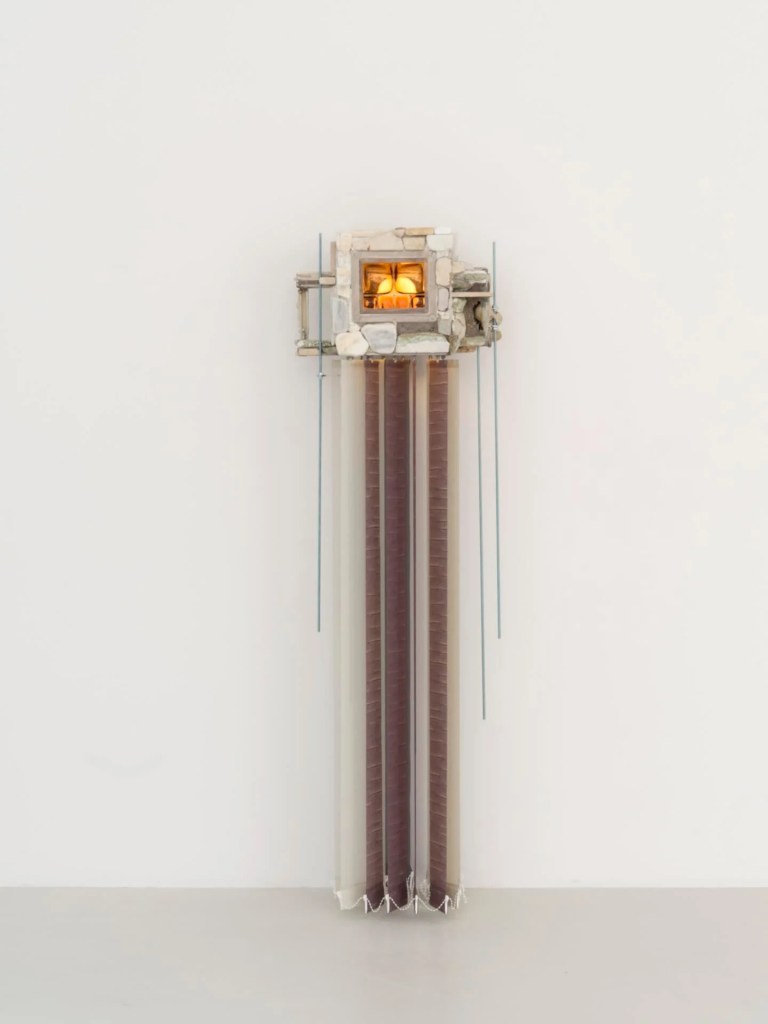
Agata Ingarden — Wall Hermit 1, 2026
Berthold Pott | A16
Agata Ingarden’s sculptural practice inhabits a territory between organic structures, architectural fragments and speculative ecosystems.
Presented by Berthold Pott, Wall Hermit 1 reflects an interest in hybrid forms and material transformation. Its title suggests a creature negotiating the boundaries of its surroundings, raising questions about shelter, adaptation and the relationships between bodies and constructed environments.
Ingarden’s work offers a quieter yet equally compelling counterpoint to the fair’s technologically driven installations.
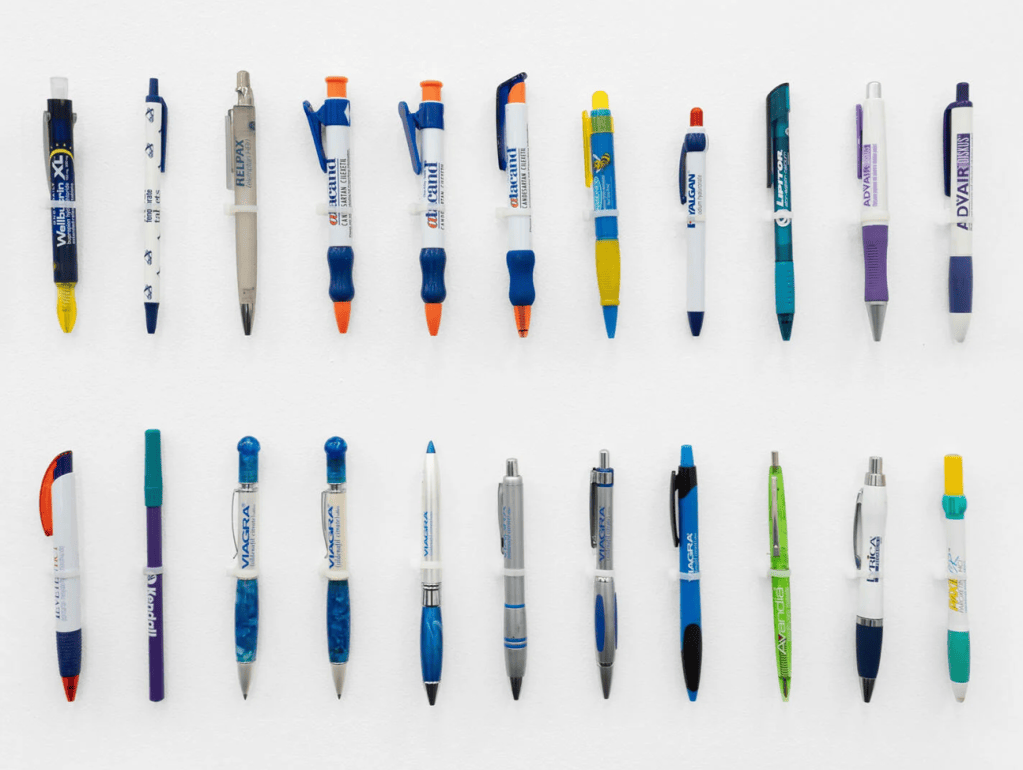
Carolyn Lazard — Portrait IV
Trautwein Herleth | The Code Universe, S03
At first glance, Carolyn Lazard’s Portrait IV appears to be a straightforward arrangement of promotional pens. Yet the objects, collected from pharmaceutical marketing materials, expose the commercial systems surrounding healthcare.
Through an apparently ordinary collection of corporate objects, Lazard considers how medicine, identity and institutional power intersect.
The work’s conceptual strength lies in its economy: an everyday object becomes evidence of a much larger system in which care and commercial interests are inseparable.
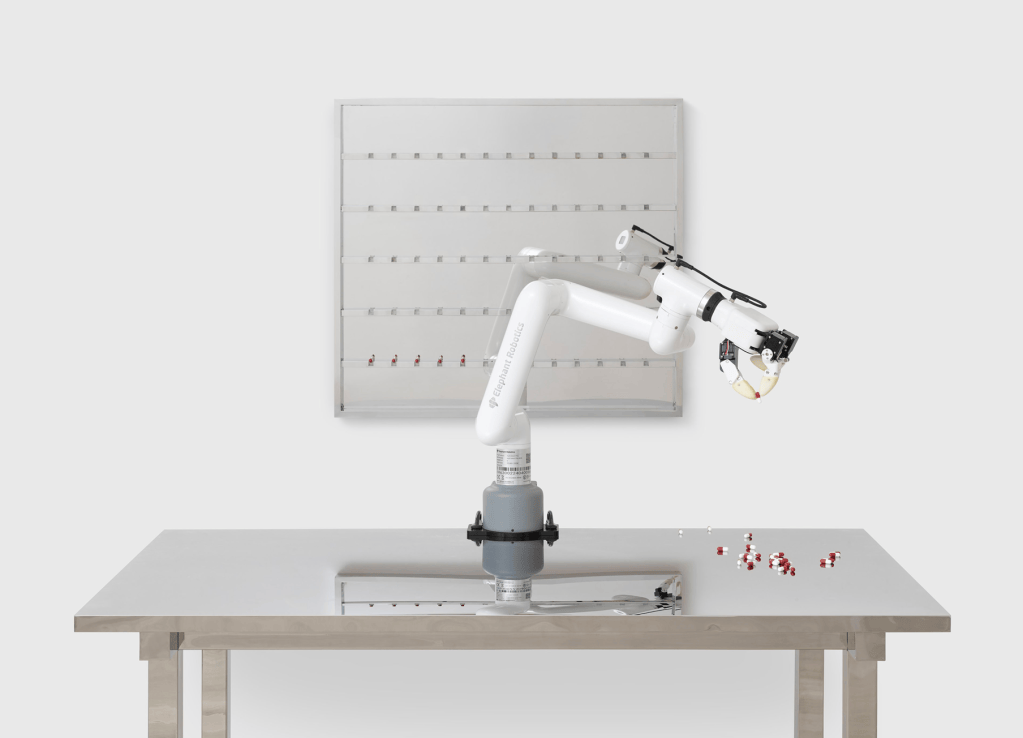
Robot, Tylenol placebo, steel shelf, and table
140 x 80 x 74 cm
Overall dimensions to be confirmed
Robot, maximum reach (approximately): 63 cm
Table: 140 x 80 x 74 cm
Shelf: 75 x 68.5 cm
Rirkrit Tiravanija — untitled 2026 (a bitter pill)
David Zwirner
Rirkrit Tiravanija introduces an automated gesture of care through a robotic arm that repeatedly offers visitors an ibuprofen tablet.
The machine continues its activity whether or not anyone accepts its offering. The repetitive action transforms a seemingly helpful gesture into something strangely indifferent.
Between automation, bodily vulnerability and the routines of contemporary life, Tiravanija’s installation raises an unsettling question: what remains of care when its delivery no longer depends on human attention?
Explore the installation in the Frieze coverage
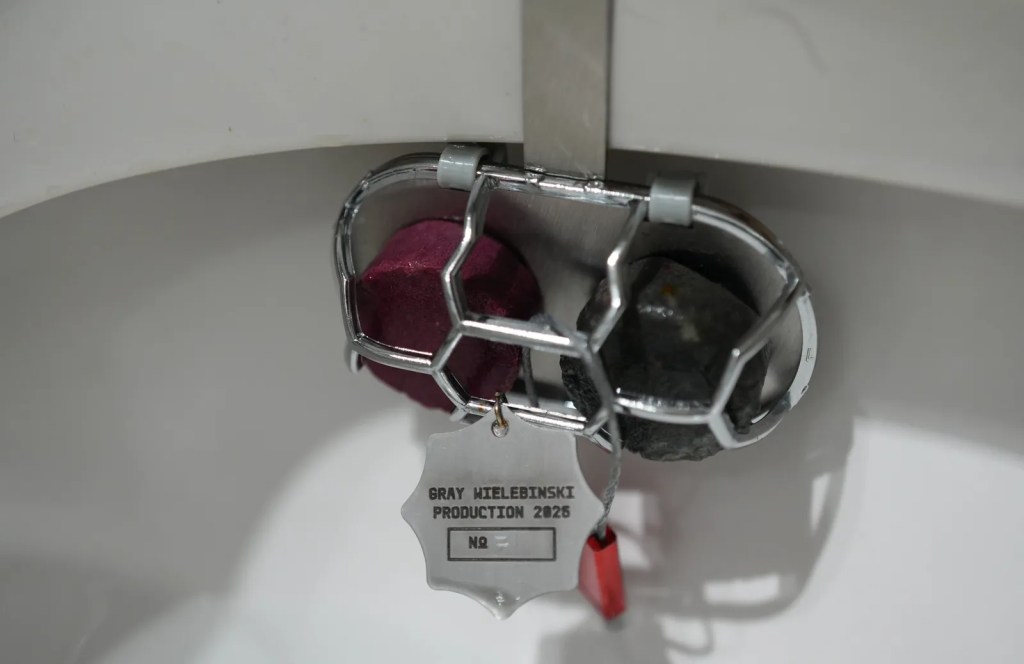
Photo: Louise Benson
Gray Wielebinski — Production, 2026
Site-specific commission | Frieze London
Moving beyond the conventional exhibition booth, Gray Wielebinski transforms the fair’s public toilets into an unexpected artistic environment.
Developed with Dean’s Bottom, Production introduces scented sculptural interventions into a space normally overlooked within the architecture of an art fair.
The project considers public and private behaviour, desire, bodily experience and the social codes governing shared spaces. By relocating art to an intimate, functional environment, Wielebinski interrupts the distinction between aesthetic experience and everyday life.
THE CODE UNIVERSE: RECONSIDERING POP CULTURE
One of the most distinctive developments in Frieze London 2026 is The Code Universe, a curated section examining the production and circulation of contemporary cultural imagery.
Bringing together artistic practices from different generations and geographical contexts, the section considers how popular culture, consumer objects and mass media have shaped the visual language of the present.
Artists including Shinro Ohtake, Selma Selman, Nikita Kadan and Carolyn Lazard approach these questions through assemblage, conceptual strategies and materially diverse practices.
Rather than identifying digital culture solely with screens and software, the section invites viewers to consider its historical foundations in consumerism, repetition and systems of representation.
FOCUS: THE IMPORTANCE OF DISCOVERY
With 35 participating galleries, Focus remains one of the most compelling parts of Frieze London.
Among this year’s presentations, Benjamin Lallier’s installation for Heidi introduces a fountain, a functioning architectural wall, live video and drawings, inviting viewers to reconsider the relationship between exhibition architecture and artistic production.
Meanwhile, Tamo Jugeli, presented by Bukia Vakhania, creates a domestic environment incorporating new paintings and William Morris wallpaper. The presentation challenges the neutrality of the conventional white-cube display, returning artworks to a setting associated with everyday life and personal attachment.
These contrasting approaches suggest that contemporary painting and installation are increasingly concerned not only with what an artwork represents, but also with the conditions in which it is encountered.
BEYOND THE MARKET
Frieze London operates within a complex relationship between artistic experimentation, institutional recognition and commercial visibility.
Yet the most memorable presentations are not necessarily those that occupy the largest spaces or command the greatest market attention.
The works highlighted here share an interest in the instability of familiar categories: the body and its digital extensions, intimacy and its commodification, care and automation, the natural and the artificial, the exhibition and the everyday.
These tensions are particularly visible in the practices of artists working across sculpture, installation, performance and new technologies, where artistic meaning is often produced through interaction rather than a fixed object.
As Frieze London 2026 continues, the fair offers an opportunity to look beyond established hierarchies and consider how emerging practices are reshaping the language of contemporary art.
Perhaps the most important discoveries are those that resist an immediate explanation, inviting the viewer to remain with uncertainty rather than consume an image and move on.
Frieze London 2026
14–18 October 2026
The Regent’s Park, London
Official website
PAI_32 — Contemporary art, emerging practices and critical perspectives.
All rights to the images belong to the artist.

