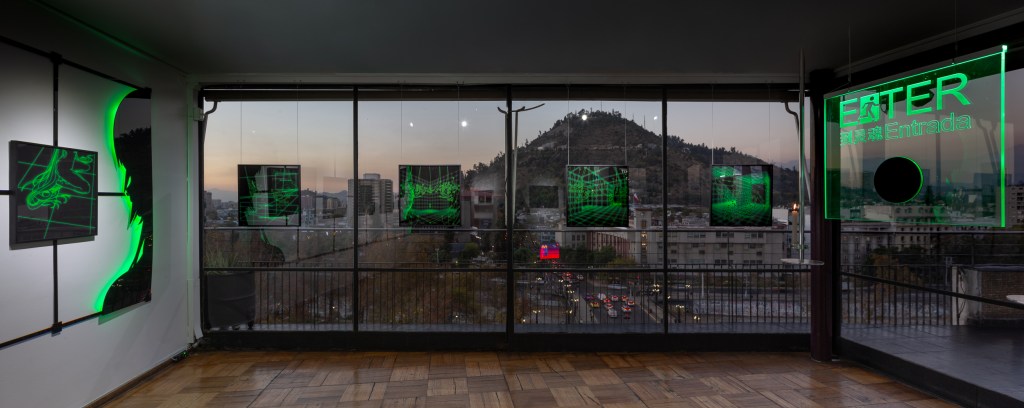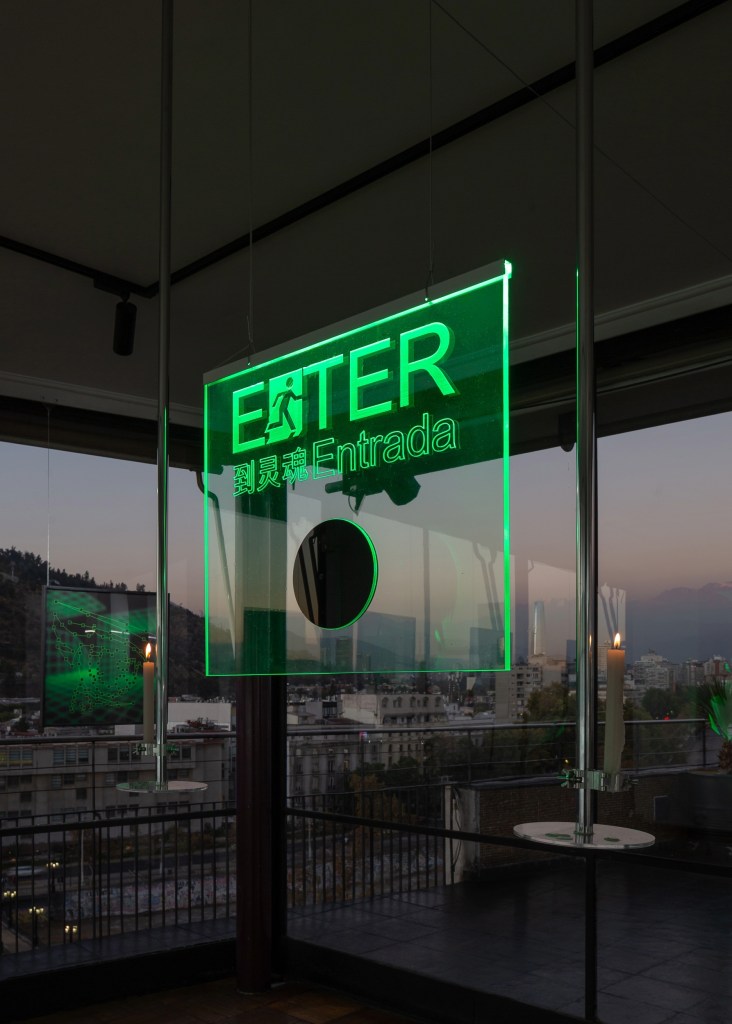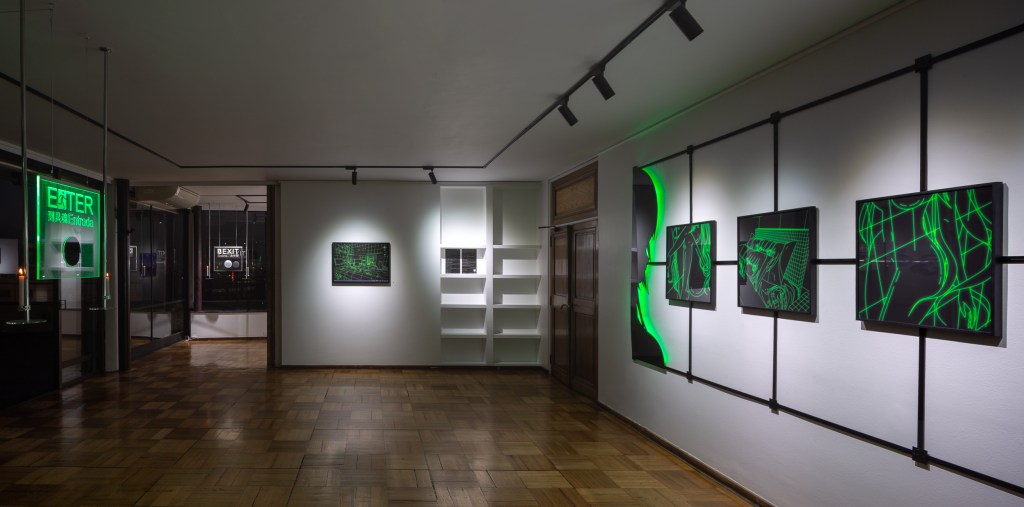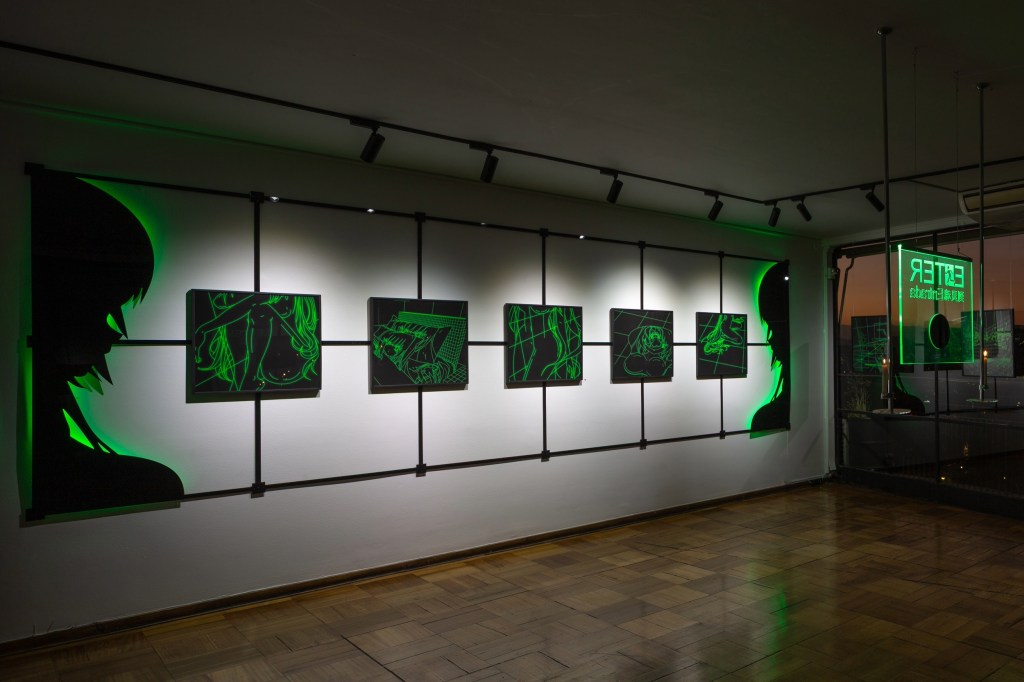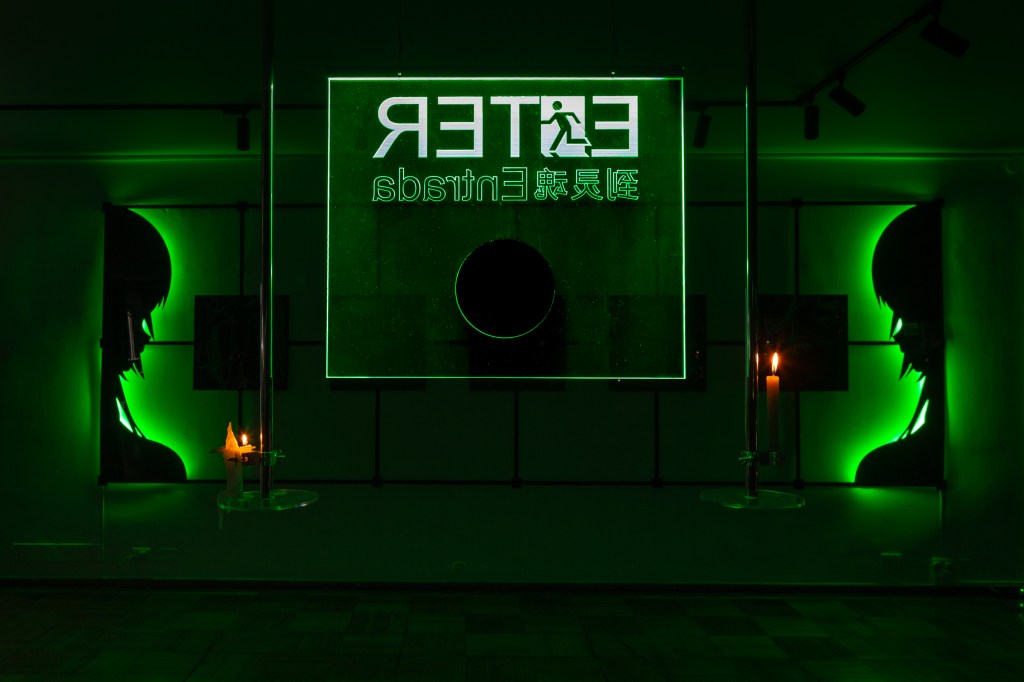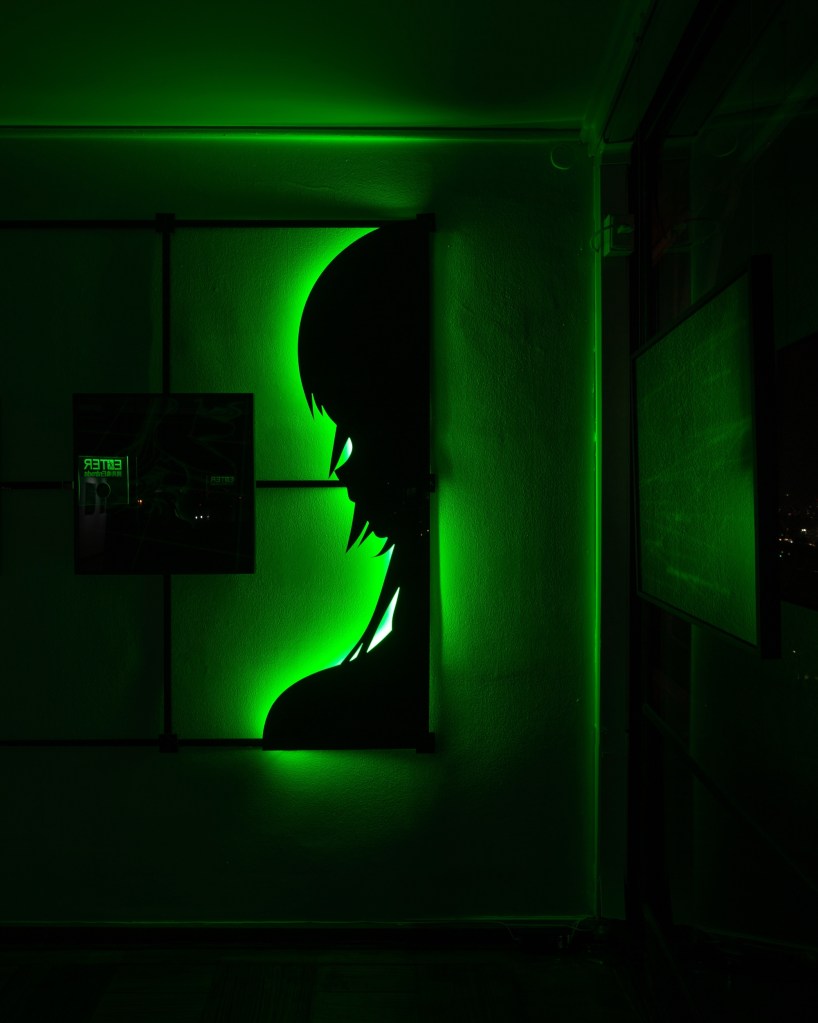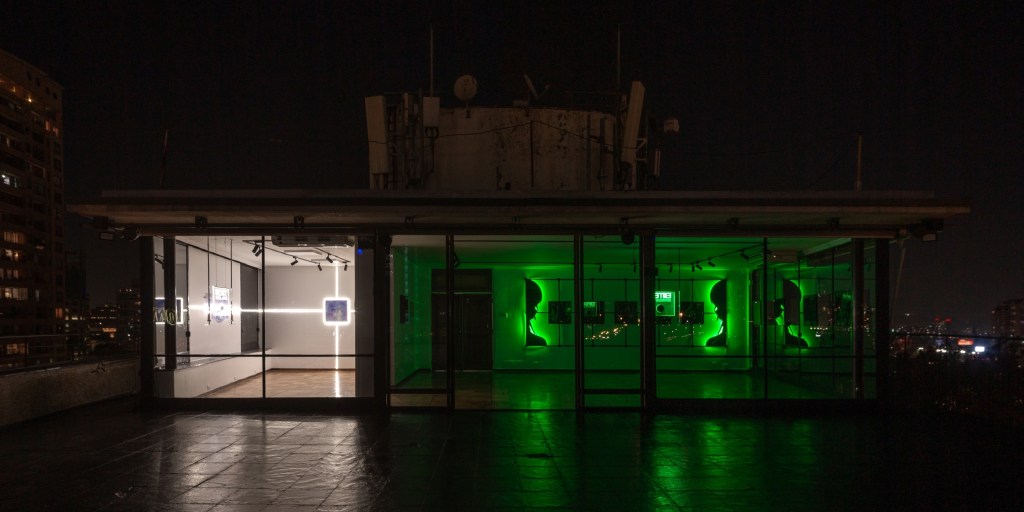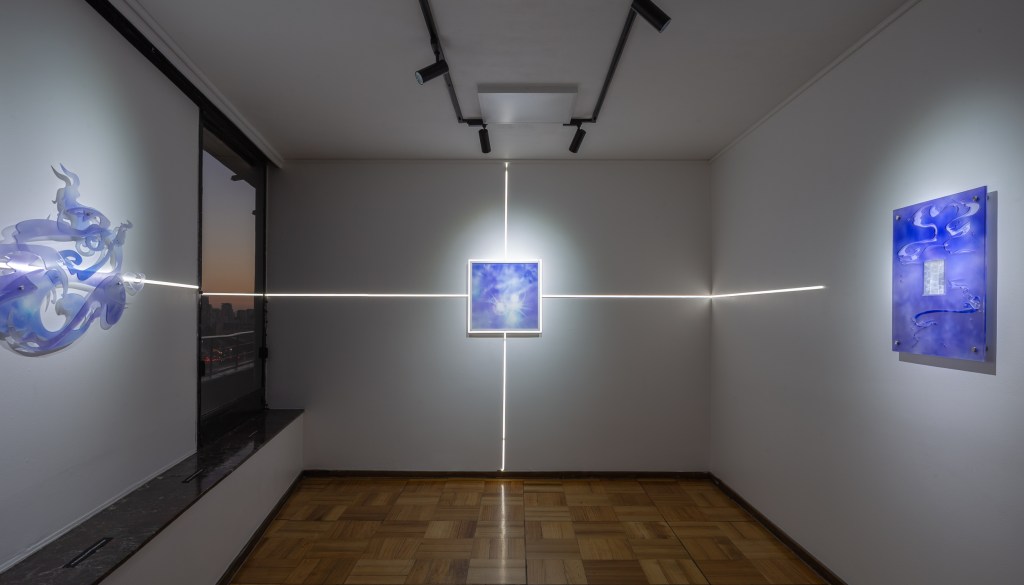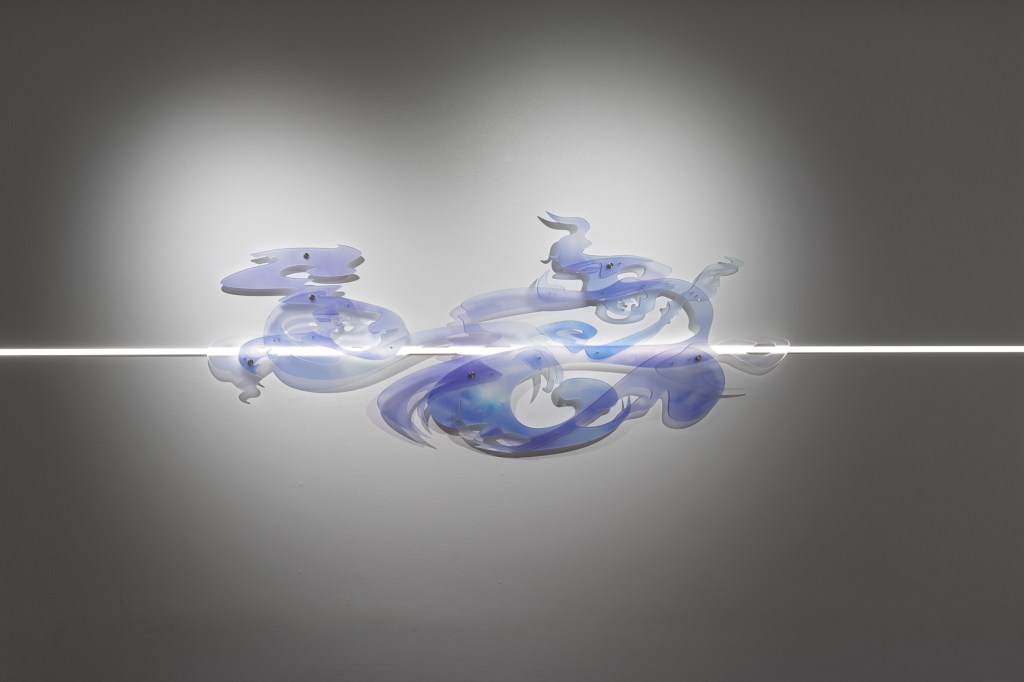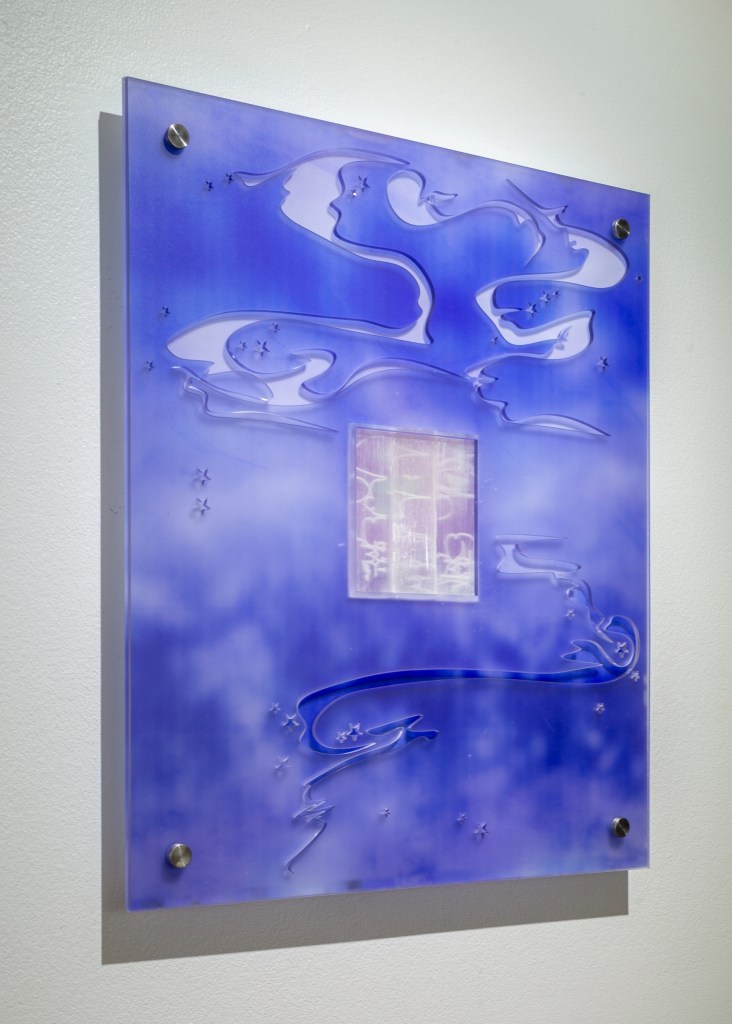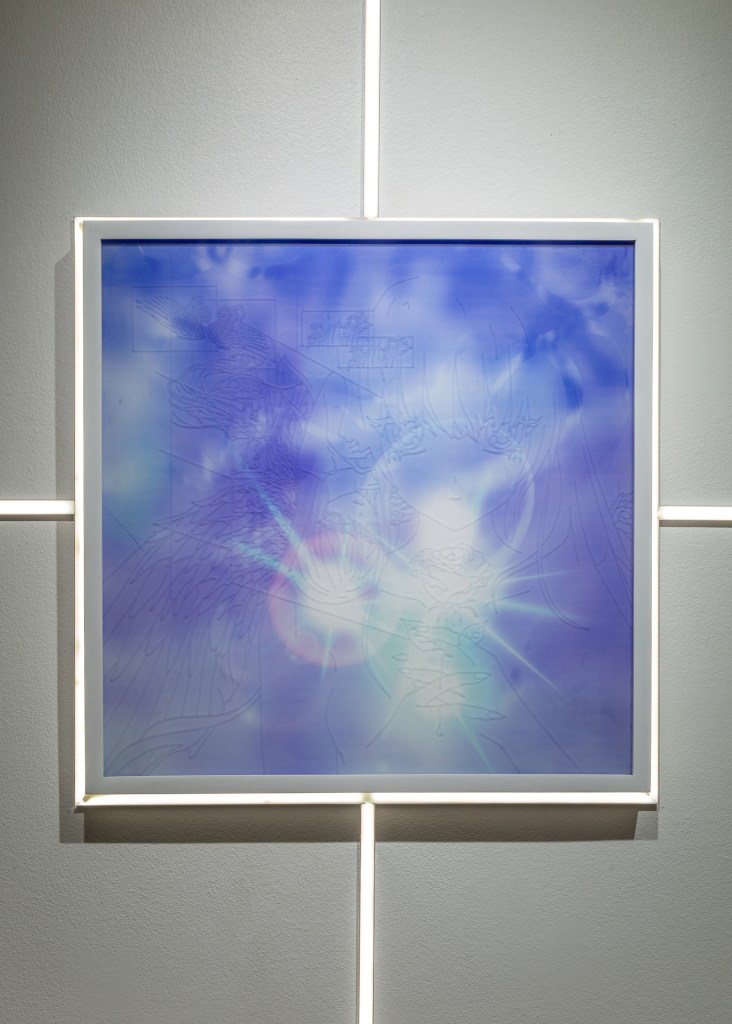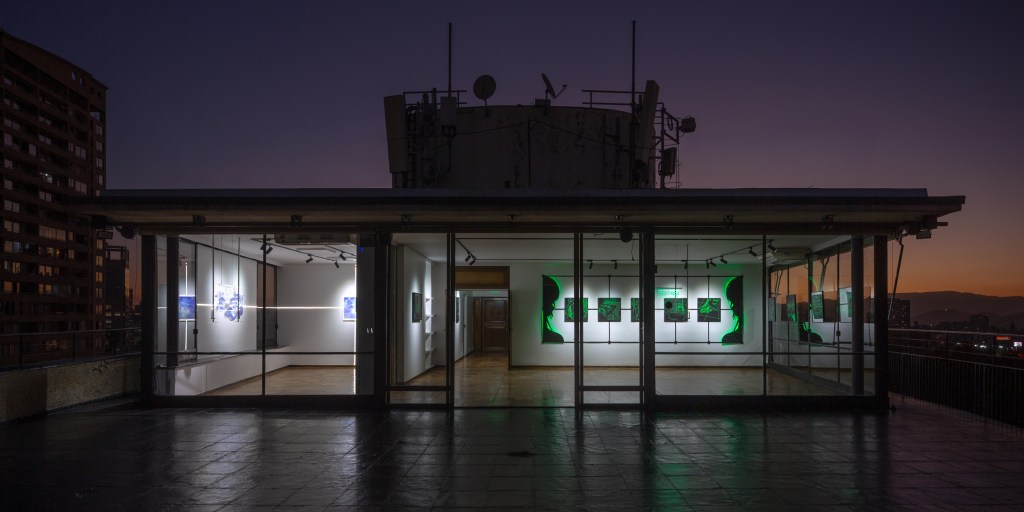
1989 + 333 LAND. Enter to the Exit, 2026. Exhibition view, Galería CIMA x SPECIFIC, Santiago
Enter to the Exit: A Ritual of Ascension within the System
Galería CIMA
Santiago, Chile.
March, April, May 2026
Instagram handles:
Text by Daniel Aguayo Mozó
In the context of its tenth anniversary, Galería CIMA, in collaboration with SPECIFIC, presents Enter to the Exit, a solo exhibition by visual artist Fabiola Morcillo. The project is conceived as a transdisciplinary system that interrogates the relationships between subjectivity, technology, and identity, situating itself critically within the expanded field of contemporary visual culture.
Rather than operating as a metaphor, the exhibition is articulated as a simulation in the strict sense: an operative environment in which each element—image, object, body—functions as a variable within a larger architecture. Within this framework, artistic practice does not represent reality but enacts it. The interface—primarily materialized through tools such as AutoCAD—becomes an active device that structures the experience, shifting the artwork from contemplation to activation.
Structured across two complementary spaces, Enter to the Exit unfolds as a navigational system between two states: 1989 and 333 Land, identities through which Morcillo develops her research. The former, associated with a design environment, operates through vector logic and the coding of the avatar; the latter is situated on a symbolic plane, where ritual and sensory dimensions function as expanded frequencies of internal manifestation. Both spaces operate as interdependent layers within the same simulation: one constructs the structure, while the other traverses it.
In this sense, the notion of identity is radically displaced. It is understood as a dynamic configuration: a profile loaded into the system, defined by attributes, limitations, memory, and potential for expansion. Each decision modifies parameters; each experience accumulates data; each error opens new bifurcations. Progress thus abandons linearity, behaving instead as a map of multiple entries and exits, where moving forward also entails getting lost, restarting, and mutating.
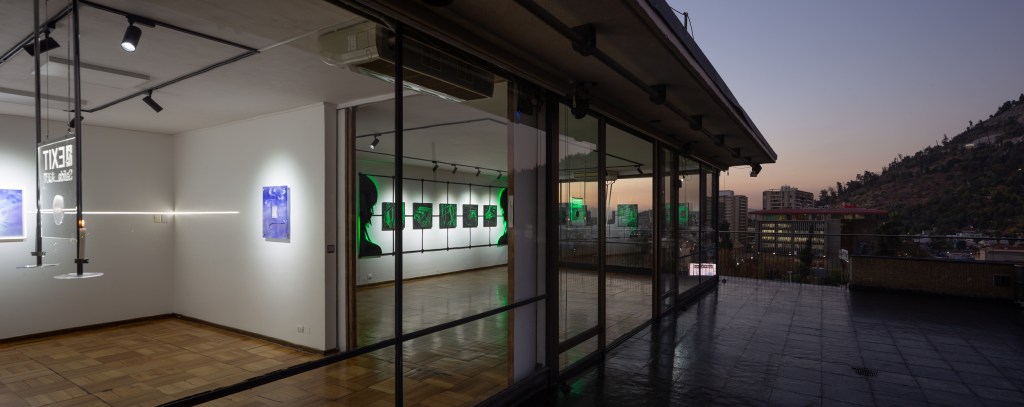
The exhibition is organized as an experiential protocol—entry, recognition, reflection, transit, and exit—through which the viewer ceases to be a passive observer and becomes a user. Within this process, the central device is the mirror, understood not merely as a reflective surface but as a reading interface: to look is to input data; to be seen is to be processed; to see oneself reflected is to participate. At this point, the work not only becomes activated but also absorbs the viewer into its operational logic, producing a collapse between user and system.
Formally, Morcillo’s proposal articulates a complex network of media: installations, mineral materials, architectural representation systems, and light technologies converge into a hybrid language where the digital and the organic coexist without hierarchy. Obsidian, selenite, and light enter into dialogue with processes such as moving image and laser engraving, configuring a perceptual field in which materiality is understood as an extension of informational logic, accompanied by a ritual dimension that takes on an alchemical dimension through interaction with candles.
Within this environment, concepts such as skill, challenge, and territory are also redefined: skills are not acquired but unlocked; challenges do not present themselves but are activated; territory is not traversed but rendered as it is inhabited. The exhibition thus demands loading time, energy consumption, and connection stability, introducing a performative dimension that translates categories from digital systems into the realm of aesthetic perception.
Access to the experience itself is framed as a critical operation. The notion of a password appears as an act of recognition: a precise correspondence between what the system expects and what the user is capable of entering. This gesture raises a fundamental question regarding the conditions of entry into contemporary experience and the ways in which subjectivity is validated within increasingly complex systems.
Curated by Daniel Aguayo Mozó, founder of SPECIFIC, the exhibition is part of an ongoing research line that understands the exhibition as a format of integral device, where artwork, space, and viewer configure a unified architecture of meaning. In this context, the recent renovation of Galería CIMA—with upgrades to its lighting system and spatial configuration—is not incidental but rather a condition that enhances the convergence between environment and artwork, amplifying the proposed immersive experience.
Enter to the Exit is therefore not defined as an exhibition in conventional terms, but as an execution environment: a space where biography operates as source code, the artwork as interface, and consciousness as a player in the process of remembering that it is also its designer.
Presented by Galería CIMA + SPECIFIC, and supported by EPSON, CNG, Demasled, LaserLaser, and Working Class, the exhibition positions itself as a complex and rigorous reflection on the construction of identity in the age of the hyperimage, offering not only a critical reading but also a direct experience of its mechanisms.